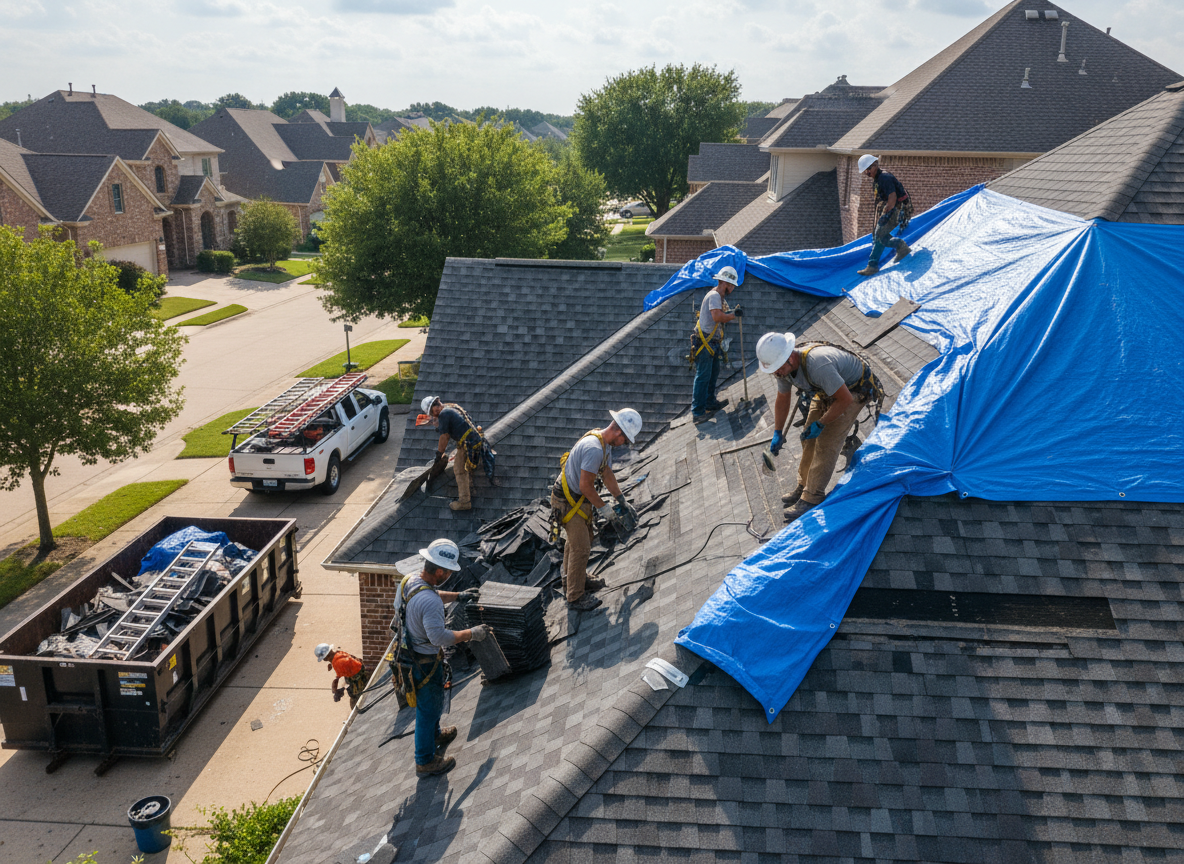
Houston storms rarely announce themselves the way people expect. A spring cell can drop golf-ball hail on Katy and Sugar Land while River Oaks gets nothing but rain, and the damage that matters most is often the damage you cannot see from the driveway. In this subtropical climate — hot, humid summers, mild winters, and repeated heavy-rain events — roofs take a beating in layers: UV cooks the asphalt, heat drives the shingle sealant loose, wind lifts tabs that never reseal, and hail bruises the mat underneath. Older homes in the Heights, Montrose and River Oaks often carry original plank decking and multiple re-roof layers, which changes how water travels once it gets past the surface. Newer builds in Pearland and the outlying suburbs have their own failure patterns, usually at valleys, pipe boots and ridge caps.
Storm damage is a diagnostic job before it is a repair job. Hail bruising shows up as soft, dark spots where granules have been knocked loose — you feel it with a hand on the slope, not with your eyes from the ground. Wind damage usually concentrates on gables, ridges and rake edges, where tabs crease, tear or peel back. Heavy rain finds the weak point: a cracked pipe boot, a lifted valley, a nail pop, a piece of step flashing that pulled away from a chimney. Water then travels along decking and rafters before it shows up as a ceiling stain, which is why a stain in a Midtown townhome or near Minute Maid Park can trace back to a failure ten or fifteen feet away.
Repair versus replacement comes down to extent, age and how the roof is put together. A handful of bruised or missing shingles on a roof with life left in it is a repair. Widespread hail bruising across multiple slopes, granule loss that leaves the mat exposed, or damage on a roof already near the end of its service life usually points to replacement — patching that kind of roof just moves the problem to the next storm. Flat and low-slope sections, common on additions, garages and commercial buildings around Downtown and the Museum of Fine Arts district, are a different conversation entirely: TPO, modified bitumen and coatings fail at seams, penetrations and ponding areas, and they get repaired on their own terms rather than with shingle methods.
Permits for roofing work vary by municipality across Harris County and the surrounding cities — Houston, Katy, Sugar Land and Pearland each handle re-roofs and structural repairs differently, and some require a permit only when decking or framing is replaced. Confirm what applies to your address before work starts, and get it in writing. Texas Roof Specialists is a statewide service-connection brand; we connect homeowners with local roofing crews who work in this climate, and RCAT Certification is referenced where a crew holds it. Ask any contractor you speak with what they hold, what they carry, and who will actually be on your roof.
How Texas Heat, UV And Heavy Rain Age A Roof Between Storms
A Houston roof is never really resting. Summer surface temperatures on a dark shingle slope can climb far above air temperature, and that heat cycles the sealant strip that holds each tab down. Once those seals release, the next moderate wind — not even a named storm — can lift tabs and let water in at the nail line. UV does the slower damage: it dries out asphalt, bleaches granules and makes shingles brittle, so hail that would bounce off a newer roof cracks an aged one. Then comes the rain. Harris County routinely sees intense, short-duration downpours, and that volume is what exposes flashing details, valley metal and pipe boots that were marginal to begin with. Add the humidity and the roof deck never fully dries between events, which is why soft decking and fungal staining turn up so often on older homes.
What Storm Damage Roof Repair Is Often Confused With
Homeowners frequently describe any post-storm leak as storm damage, and the distinction matters. A leak that appears after a storm may be storm damage — a torn boot, a displaced shingle, a punctured valley — or it may be an age-related failure the storm simply revealed, such as a rusted-through flashing pan or a valley that has been leaking slowly for a year. Another common mix-up is hail bruising versus granule loss from ordinary weathering; both look dark from the ground, but only one is impact damage. Wind damage is also confused with installation defects, particularly on ridges and gables where a poorly sealed cap can lift in a breeze that would not trouble a correctly installed roof. A proper inspection separates these, because the repair and the conversation with your contractor differ in each case.
Seasonal Guidance For Houston-Area Roofs
Spring and early summer bring the most violent cells — hail, straight-line wind and torrential rain — so a pre-season look at ridges, gables and penetrations pays off before the first big event. Late summer is heat and UV season, when sealant strips release and attic temperatures peak; this is when small lifts turn into leaks. Hurricane season runs through late fall, and the concern shifts to sustained wind, wind-driven rain and debris impact, plus the tree limbs that come down over older Heights and Montrose lots. Winter here is mild, but the occasional hard freeze still matters for flashing sealants and for any roof that has been holding moisture. A short inspection after each significant storm is the cheapest habit a Texas homeowner can keep.
Roof Systems We Work With
Asphalt shingle roofs remain the standard across most Texas residential neighborhoods, and they are the most common candidate for storm repair — individual shingles, ridge caps and valley sections can often be replaced in isolation if the surrounding field is sound. Metal roofing handles hail and wind differently: panels dent rather than bruise, fasteners and seam sealants are the usual failure points, and repairs are about resealing and re-fastening rather than swapping material. Tile and concrete roofs crack and slip, and repairs involve matching profile, underlayment and fastening. On flat and low-slope sections — TPO, modified bitumen, and coating systems — the work is seam repair, penetration detailing and drainage correction, not shingle work. Matching the repair method to the system on your roof is what keeps a fix from becoming a recurring problem.
Technician insight
In Houston, the thing that catches most people out with storm damage roof repair is the delay — a leak shows up as a ceiling stain in Montrose or the Heights weeks or months after the storm that caused it, because water has been traveling along the decking first. On the older bungalows here, that decking is often original plank with no underlayment, so a small flashing failure spreads fast and soft spots appear well away from the visible damage. The other mistake is judging hail damage from the ground: bruising on a shingle mat is a feel-and-look-at-the-slope problem, and on a roof that has already been baked by a decade of Texas UV, hail that would have bounced off a newer roof will crack what is up there.
Hail Bruising Found Weeks After A Heights Storm
A homeowner in the Heights called about a brown ceiling stain that appeared well after a spring hailstorm had passed, with no obvious missing shingles from the ground. On the roof we found hail bruising concentrated on the north-facing slope, a cracked pipe boot, and soft decking near a valley where water had been running undetected. We replaced the affected shingles, installed a new pipe boot, cut out and replaced the soft decking section, and checked the attic side after a water test. The leak stopped and the rest of the roof was left in place, with the remaining slopes noted for future monitoring.
Storm Damage Roof Repair Services We Offer
✓Hail Damage Roof Repair
Assessment and repair of hail bruising, granule loss and cracked shingle mats after a hail event. We separate true impact damage from ordinary weathering so you know what actually needs work.
✓Wind Damage Roof Repair
Repair of lifted, creased and torn shingles on ridges, gables and rake edges, plus re-sealing of tabs that released in straight-line wind. Includes a check of ridge caps and edge metal.
✓Roof Leak Repair After Storms
Tracing active leaks back to their source — pipe boots, valleys, step flashing, nail pops — rather than patching the ceiling stain. Water often enters well away from where it shows up inside.
✓Emergency Roof Tarping
Temporary tarping to limit water intrusion after a storm while a permanent repair is scheduled. Tarping is a stopgap, not a fix, and we will tell you what still needs to be done.
✓Missing Shingle Replacement
Replacement of shingles blown off in high wind, with attention to matching profile and color as closely as available stock allows. Includes inspection of the surrounding field for loosened tabs.
✓Storm-Damaged Flashing Repair
Repair or replacement of chimney, wall, valley and vent flashing that pulled loose, corroded or was punctured during a storm. Flashing failures are among the most common hidden sources of leaks.
✓Post-Storm Roof Inspection
A slope-by-slope and attic-side look after a significant storm, documenting what we find on shingles, decking, flashing and penetrations. Useful for deciding between a targeted repair and a larger scope.
How it works
- 1
Storm Damage Assessment
We walk the roof and the attic, checking slopes, ridges, valleys, flashing and penetrations, and look for bruising, granule loss, lifted tabs and soft decking. Interior staining and attic daylight are noted so the leak path can be traced rather than guessed.
- 2
Findings And Scope Options
You get a plain explanation of what failed and why, with the realistic options: a targeted repair, a partial scope, or replacement. Where the damage is marginal or the roof is near end of life, we say so instead of selling a patch that will not hold.
- 3
Permits And Scheduling
Permit requirements vary by municipality across the Houston area and the surrounding cities, so we confirm what applies to your address before work begins. Scheduling accounts for weather windows, since roofing in a Texas downpour helps no one.
- 4
Repair And Water Testing
Damaged shingles, flashing, boots and decking sections are replaced, then the repaired area is checked with water where conditions allow. Attic-side inspection confirms the leak path is closed before we call it done.
- 5
Walkthrough And Next Steps
We review what was replaced, what was left alone and why, and flag anything worth watching on the rest of the roof. If a larger scope is likely down the road, you hear it now rather than after the next storm.
Pricing
Storm damage repair pricing in the Houston area is driven by scope, not by a flat rate: how many slopes are affected, whether flashing or decking has to be replaced, the roof system involved, and how steep or accessible the roof is. A single shingle or boot repair sits at the low end; multi-slope hail or wind damage with decking work sits much higher, and replacement is a different budget entirely. Confirm permit costs for your city separately, since Houston, Katy, Sugar Land and Pearland handle roofing permits differently.