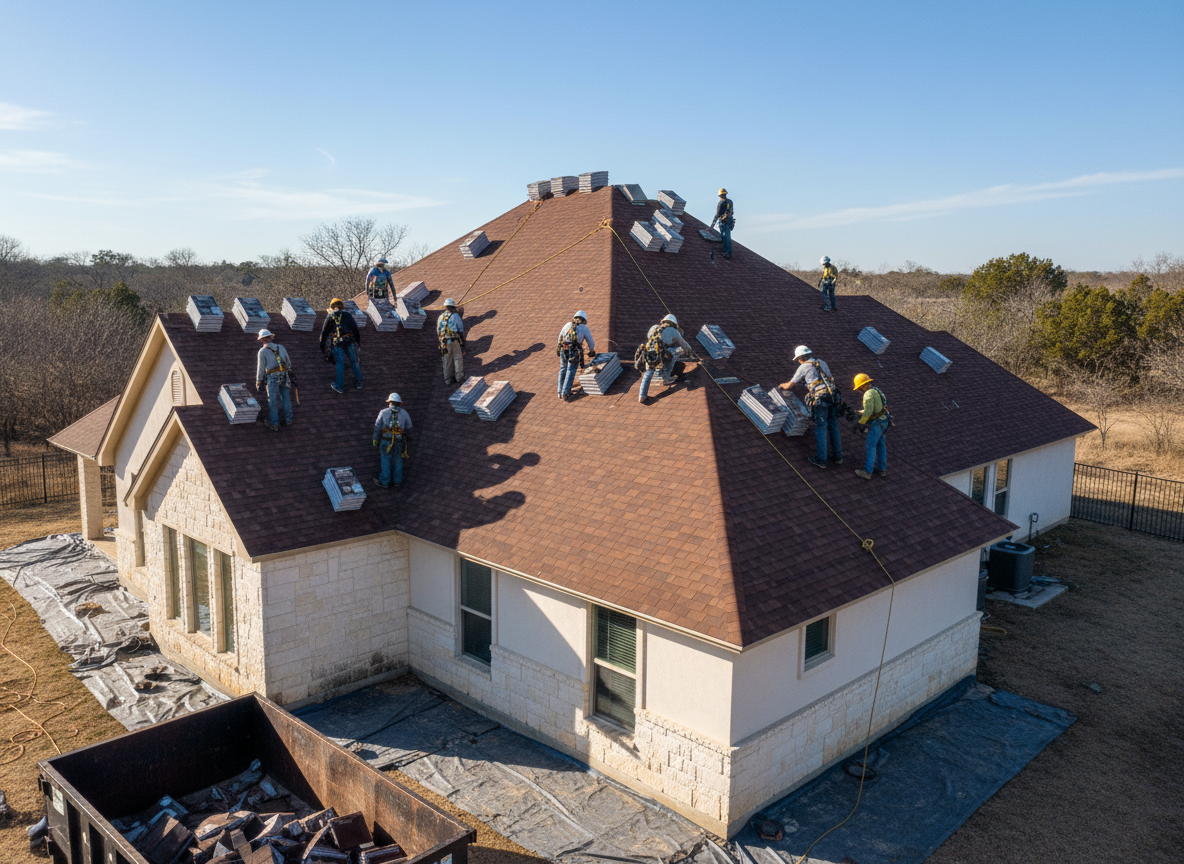
A roof installation in Houston is a different job than the same install in Dallas or Amarillo, and the housing stock makes it more different still. In the Heights and Montrose you are often working on 1920s–1940s bungalows with pier-and-beam framing, 1x6 skip sheathing instead of plywood, and rafters that have been patched more than once. In River Oaks and parts of Midtown the roofs are steeper and more complex, with dormers, valleys and multiple tie-ins that eat labor hours. Out in Katy, Sugar Land and Pearland, the subdivisions are newer and the roof geometry is simpler, but production-built trusses and thin original decking mean the tear-off reveals problems the homeowner never saw from the ground.
The Gulf Coast subtropical climate is the single biggest driver of what a roof installation has to account for. Summers run hot and humid for months, and the sun load on a west-facing slope is brutal — asphalt mat oxidizes, sealant strips soften, and granules shed faster than they do inland. Winters are mild, so freeze-thaw is rarely the issue; instead you get wind-driven rain from tropical systems, hail bands that move through Harris County in spring, and standing water on low-slope sections that never drains because the original slope was marginal. A roof installed here needs correct underlayment, proper flashing detail at penetrations, and ventilation that actually moves attic heat rather than just meeting code on paper.
Material choice follows the building, not a sales sheet. Architectural asphalt shingle remains the practical default for most pitched residential roofs across Harris County because it balances cost, wind rating and repairability. Standing seam metal suits homeowners who want a longer service life and better performance against UV and hail, and it is common on rural and newer custom builds. Clay and concrete tile show up on Mediterranean and Spanish-influenced homes in River Oaks and West University, but tile is heavy — the structure has to be checked before anyone commits. For flat and low-slope roofs, including commercial buildings Downtown and in Midtown, TPO membrane and coatings are the realistic systems; nailing shingles onto a 2:12 slope is a failure waiting to happen.
Permits are not uniform across the region. The City of Houston, Katy, Sugar Land and Pearland each handle roofing permits and inspections differently, and some jurisdictions require a permit only above a certain scope or value while others want one for any full tear-off. Homeowner association rules in the master-planned communities add another layer, often dictating approved shingle colors and profiles. Confirm the permit requirement for your specific address and scope before work starts, and get the decking, ventilation and flashing scope written into the agreement rather than agreed verbally on the day of tear-off.
How Gulf Coast Weather Actually Wears Out a Roof
Houston's roof-killers are not the ones homeowners expect. Freeze-thaw gets the attention, but the real damage comes from sustained UV exposure, humidity that keeps decking and underlayment damp, and wind-driven rain pushed sideways under shingle edges during tropical systems. Sealant strips that hold tabs down soften in summer heat and re-harden in mild winters, so shingles that looked fine in October can lift in the next spring storm. Hail in Harris County tends to arrive in narrow bands, which is why one street can need a full replacement while the next street over has nothing. On low-slope sections, the failure mode is almost always ponding water and seam separation rather than impact damage — a different problem requiring a different system entirely.
Repair or Replace: What Tips the Decision
A roof installation is the right call when the decking is compromised, when the roof has already been patched across multiple areas, or when the existing system is at the end of its service life and every storm brings another leak. Repair makes more sense for isolated damage — a single flashing failure at a chimney, a wind-lifted section on one slope, a valley that has worn through while the rest of the roof is sound. Age matters, but condition matters more. A 15-year-old roof that has been re-decked and well ventilated can outperform a 10-year-old roof that sat over a hot, unvented attic. The honest answer usually comes from getting on the roof and looking at the decking, not from a number on a calendar.
What to Discuss With Your Contractor
Before signing anything, walk through the tear-off scope, what happens if rotten decking is found, which underlayment and flashing materials are specified, how attic ventilation will be handled, and who pulls the permit. Ask how the crew will protect landscaping and how debris leaves the property. Ask whether the quote covers ridge vent, drip edge, pipe boots and valley treatment or treats them as add-ons. Get the manufacturer's material specification in writing so you know exactly what is going on your house, and confirm the workmanship terms in the contract rather than relying on a verbal promise.
Timing a Roof Installation on the Gulf Coast
Roofing in Houston runs year-round, but the calendar shapes the job. Summer installs mean crews start early and decking gets hot enough to matter for sealant adhesion; late-afternoon storms can halt a tear-off mid-day, so a dry-forecast window matters more here than in drier markets. Spring brings hail bands and the busiest scheduling of the year. Late fall and winter are often the easiest windows to get on a crew's schedule, and the milder temperatures are friendlier to shingle handling. If your roof is already leaking, timing is no longer a preference — water intrusion into decking and insulation compounds the cost the longer it runs.
Technician insight
In Houston, the thing that catches most people out with roof installation is the decking. On older Heights and Montrose bungalows you are often pulling up 1x6 skip sheathing that has been wet and patched for decades, and the quote that looked competitive suddenly needs a full redeck. The second thing is attic ventilation — a hot, humid attic cooks shingles from underneath, so a new roof installed over the same inadequate ventilation will age faster than the homeowner expects. Get both priced and specified before tear-off day, not during it.
Skip Sheathing Found Under a Heights Bungalow Re-Roof
A homeowner in the Heights called about a persistent ceiling stain near a rear addition, and the roof was old enough that patching it again made no sense. On inspection we found the rear slope had been layered over at least twice, and underneath was original 1x6 skip sheathing with soft, delaminated boards near the valley. We tore off to the rafters, replaced the compromised sheathing with plywood, installed new synthetic underlayment and rebuilt the valley flashing before laying architectural shingle. The stain stopped recurring through the following rainy season, and the homeowner now has decking they can actually inspect.
Roof Installation Services We Offer
✓Asphalt Shingle Roof Installation
Architectural and dimensional shingle systems for pitched residential roofs, specified for wind uplift and UV exposure common across Harris County. Includes underlayment, drip edge, valley treatment and ridge ventilation.
✓Metal Roof Installation
Standing seam and metal panel systems for homeowners wanting a longer service life and better performance against sun load and hail. Panel profile, gauge and fastener detail are matched to the roof pitch and structure.
✓Tile Roof Installation
Clay and concrete tile installation for Mediterranean and Spanish-style homes in River Oaks and similar neighborhoods. Structural capacity is verified before install because tile weight is substantially higher than shingle.
✓Flat and Low-Slope Roof Installation
TPO membrane and coating systems for flat and low-slope roofs on homes, garages and commercial buildings in Midtown, Downtown and beyond. Correct slope, drainage and seam detail matter more than material brand on these roofs.
✓Roof Decking and Underlayment Replacement
Replacement of deteriorated plywood, OSB or older skip sheathing discovered during tear-off, plus new synthetic underlayment. Common on older Heights and Montrose homes where original decking has been wet for years.
✓Attic Ventilation and Ridge Vent Installation
Intake and exhaust ventilation balanced for hot, humid attics — ridge vent, soffit vent and, where appropriate, powered ventilation. Poor attic ventilation shortens shingle life from underneath as much as sun shortens it from above.
✓Storm-Damaged Roof Replacement
Full tear-off and re-roof after hail, wind or tropical-system damage, with decking inspection and flashing rebuild. Documentation of the existing condition is gathered before work begins so the scope is clear.
How it works
- 1
Roof Assessment and Scope Definition
We get on the roof, inspect decking, flashing, valleys, penetrations and attic ventilation, and document what we find. You get a written scope covering tear-off, materials, decking contingencies and ventilation before any work is scheduled.
- 2
Material and System Selection
Shingle, metal, tile or low-slope membrane is chosen against your roof pitch, structure, HOA rules and budget. We walk through the manufacturer specification so you know the exact underlayment, flashing and accessory products going on the roof.
- 3
Permits and Scheduling
Permit requirements vary by municipality — Houston, Katy, Sugar Land and Pearland each handle roofing permits differently — so we confirm what your address requires and pull it where applicable. Scheduling is set around a dry-forecast window.
- 4
Tear-Off and Decking Inspection
Existing roofing is removed and the decking is inspected board by board. Rotten or delaminated decking is replaced and photographed, and any structural concerns are raised before the new system goes down.
- 5
Installation, Cleanup and Walkthrough
Underlayment, flashing, field roofing, ridge ventilation and accessories are installed to the specified system. The site is magnet-swept for nails, debris is hauled off, and we walk the finished roof with you before closing out.
Pricing
Roof installation pricing in the Houston area is driven mainly by roof size and pitch, the number of valleys, dormers and penetrations, the material system selected, and how much decking has to be replaced once the old roof comes off. Low-slope membrane work is priced differently from pitched shingle work because the labor and detailing are different trades. Expect the decking contingency to be the line item that moves the final number most — it is unknowable until tear-off.