What a Roof Inspection Actually Covers in Houston
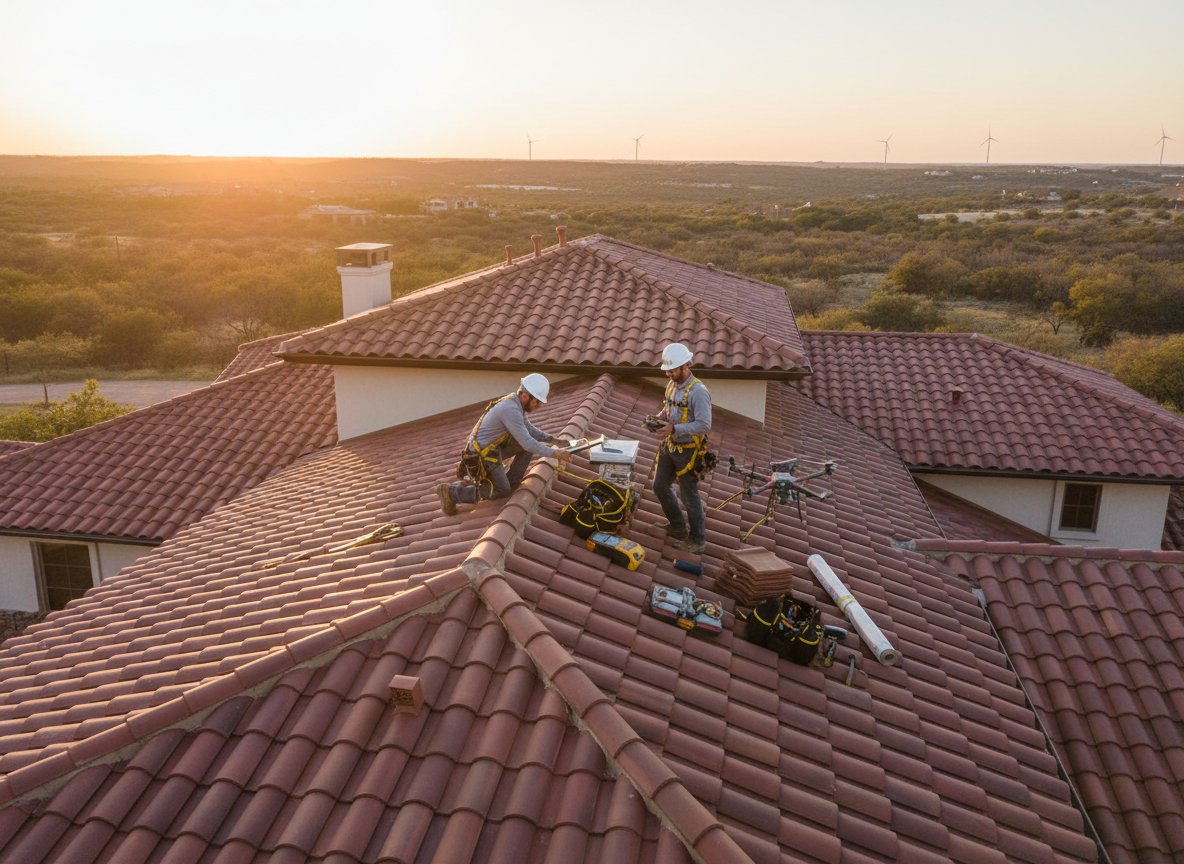
A real inspection starts on the ground and works up. We look at the roof plane from several angles to spot lifted, cracked or missing shingles, then walk the field where it's safe to do so. From there it's the details that fail first: pipe boots, chimney and wall flashings, valley metal, drip edge, ridge caps, and every penetration a satellite dish or vent left behind. Inside the attic we check for daylight, stained decking, rusted nail heads, sagging sheathing and ventilation gaps. Finally we look at gutters, downspouts and how water leaves the property. In a subtropical climate with hot humid summers and mild winters, the attic is often where the story shows up first — long before a ceiling stain appears in a living room.
Why Texas Roofs Age Faster Than the Calendar Suggests
Roofing here takes a compound beating. Summer UV bakes asphalt shingles until granules loosen and the mat dries out; attic temperatures climb and cook the underside of the deck. Then a hail core moves through Katy or Sugar Land and knocks granules off in patches you can't see from the driveway. Wind-driven rain — the kind that comes sideways off the Gulf — pushes water past flashings that shed a straight-down shower just fine. Add the humidity that keeps wood damp for weeks and you get decking that rots faster than it would in a drier state. A roof that looks fine from the street at five years old can already have soft sheathing and tired pipe boots. That gap between appearance and condition is exactly why a hands-on inspection matters more here than a visual glance.
Roof Systems Behave Differently — So Do Their Inspections
Asphalt shingles are the default across Harris County, and they fail by granule loss, thermal cracking, lifted tabs and nail pops. Metal standing seam holds up well against UV and wind but lives or dies on fastener and sealant condition and on whether the panels were installed over a proper underlayment. Tile — clay and concrete — is common in older River Oaks and Montrose homes; the tile itself can outlast the house while the underlayment beneath it quietly expires, which is why a tile inspection is really an underlayment inspection. Flat and low-slope roofs on Midtown and Downtown buildings, plus garage and porch additions, are usually TPO, modified bitumen or a coating system, and they fail at seams, drains, scuppers and ponding areas rather than at shingle edges. Inspecting a low-slope membrane the way you'd inspect a shingle roof misses the actual failure points.
Repair or Replace: What Tips the Decision
We look at four things: how widespread the damage is, how old the roof is relative to its material, whether the decking underneath is sound, and whether the problem is a single detail or a systemic one. A cracked pipe boot, a failed valley or a handful of wind-lifted tabs on an otherwise healthy roof is a repair. Widespread granule loss, multiple active leaks in different areas, soft or delaminated sheathing, or a roof already at the end of its service life points toward replacement — because patching it just moves the next leak a few months down the road. We also weigh whether the roof is repairable in a way that keeps a consistent material and color, since mismatched patches on a faded roof are visible from the street. You get the reasoning, not just a verdict.
Technician insight
In Houston, the thing that catches most people out with roof inspection is that the leak almost never starts where the stain shows up. Water enters at a pipe boot, a wall flashing or a valley, runs along a rafter or the top of the deck, and drops onto the ceiling ten feet away — so homeowners point at the wrong spot and get the wrong thing patched. The second surprise is the attic: in this humidity, decking in a poorly ventilated attic stays damp long enough to rot and delaminate, and that's true even on roofs that look perfectly fine from the street. On the older bungalows around the Heights and Montrose, original plank decking and decades of layered repairs mean you have to look at what's under the shingles before you can honestly say whether a repair will hold.
Ceiling Stain That Traced Back to a Chimney Flashing
A homeowner near the Heights called about a brown ring spreading on a bedroom ceiling after a stretch of heavy rain, convinced the shingles above the room were failing. The shingle field over that room was actually in reasonable shape; the water was entering at the chimney flashing on the opposite slope, running down a rafter and dropping onto the ceiling well away from the entry point. We repaired the counter-flashing and sealed the step flashing joints, then re-checked the attic after the next rain to confirm the path was dry. The ceiling stain was cosmetic at that point — the roof itself didn't need replacing.
Roof Inspection Services We Offer
✓Storm and Hail Damage Inspection
A close inspection of roof planes, ridges, vents and soft metals after a hail or wind event, documenting granule loss, bruising, dents and lifted or missing shingles. Useful for understanding the extent of damage before you decide on roof repair or replacement.
✓Roof Leak Detection
Tracing an active leak from the ceiling stain back to its actual entry point, which is often a flashing, pipe boot or valley rather than the spot where water shows up inside. Includes attic-side verification of the wet path.
✓Pre-Listing and Real Estate Roof Inspection
A condition review for homeowners preparing to sell and for buyers who want to know what they're inheriting. Covers remaining service life, active and old leaks, decking condition and items a buyer's inspector is likely to flag.
✓Asphalt Shingle Roof Inspection
Granule loss, thermal cracking, lifted tabs, nail pops, ridge cap condition and flashing integrity on the most common roof type in Harris County. Identifies whether the shingle field is repairable or past its useful life.
✓Metal and Tile Roof Inspection
Fastener, sealant and panel condition on standing seam, plus underlayment assessment on clay and concrete tile where the tile outlasts what's beneath it. Tile and metal are inspected for the system they are, not as shingle roofs.
✓Flat and Low-Slope Roof Inspection
Seam, drain, scupper and ponding review on TPO, modified bitumen and coating systems found on Midtown and Downtown buildings, garages and porch additions. Focuses on membrane failure points rather than shingle wear.
✓Attic, Decking and Ventilation Inspection
Checking for daylight, water staining, rusted fasteners, soft or delaminated sheathing, and blocked or missing ventilation that traps heat and moisture under the deck. Often the fastest way to confirm whether a leak is active.
How it works
- 1
Ground-Level and Roof Walk
We start from the perimeter to read the roof lines, then walk the field where it's safe, checking shingles or membrane, flashings, penetrations, valleys, ridge and drip edge. Steep, fragile or wet roofs are assessed from a ladder and from inside the attic rather than walked.
- 2
Attic and Drainage Review
Inside, we look for daylight, staining, rusted nails, soft decking and ventilation problems that point to where water is actually getting in. Outside, we check gutters, downspouts, and how runoff leaves the property — a roof can be fine while drainage is quietly damaging fascia and foundation beds.
- 3
Documented Findings
You get a plain-language summary of what we saw, with photos of the specific conditions, separating active problems from items worth watching. No pressure to decide on the spot — the point is that you can see what we saw.
- 4
Repair, Replace or Monitor Options
We lay out what a targeted roof repair would address, what a roof replacement would address, and what genuinely doesn't need attention yet. If a repair would only postpone the problem, we say so and explain why.
- 5
Scope, Permits and Follow-Up
If work moves forward, we define the scope in writing and confirm what the local municipality requires — permitting rules differ between Houston, Katy, Sugar Land and Pearland. After any repair we re-check the area to confirm the leak path is closed.
Pricing
Inspection pricing here is driven by access and complexity, not by a flat rate. A single-story ranch with a walkable pitch takes far less time than a steep two-story in the Heights or a tile roof in River Oaks, where the inspection is really about the underlayment beneath the tile. Roof size, number of roof levels, material type, and whether the roof can be walked or has to be assessed from ladders and attic access all move the number. Flat and low-slope systems on Midtown and Downtown buildings take longer because seams, drains and ponding areas each need individual attention. If you need written documentation for a real estate transaction, that report takes additional time and is priced accordingly. Ask what the inspection includes before it starts — a walk-around glance and a full attic-and-drainage review are not the same service.