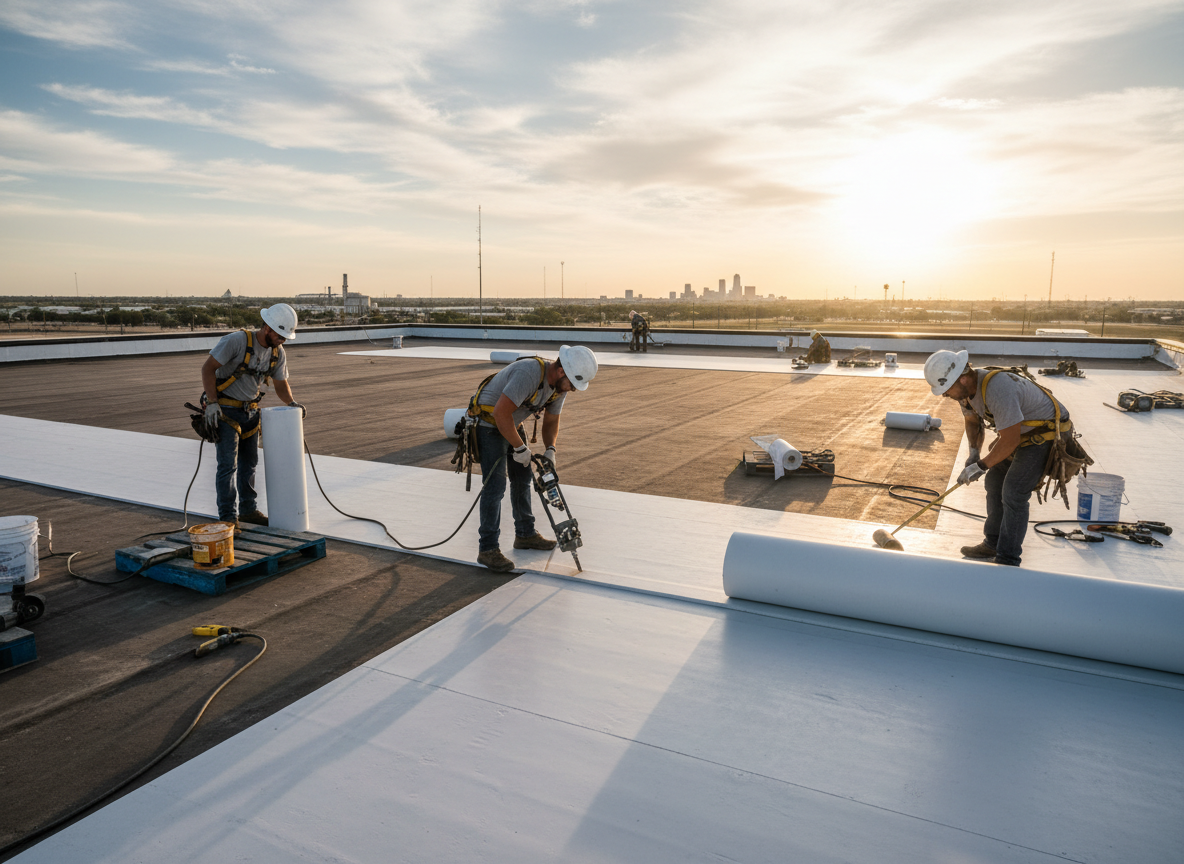
TPO roofing is a single-ply thermoplastic polyolefin membrane made for flat and low-slope roofs. In Houston, that means the flat sections over garages, additions, porches, and commercial buildings from Montrose and River Oaks to the Heights, Midtown, and Downtown. It is also common on properties near the Houston Zoo, Museum of Fine Arts, Space Center Houston, and Minute Maid Park. TPO is not a steep-slope shingle replacement; it is a system of membrane, insulation, cover board, fasteners, and heat-welded seams. Homeowners and property owners search for roof repair when a seam opens or a drain backs up, and for roof replacement when the membrane is aged, hail-bruised, or holding water. The right answer depends on the roof deck, drainage, and how much of the system has failed.
Texas heat and humidity are hard on any low-slope roof. TPO is designed to reflect sunlight and resist UV, but the membrane expands and contracts through hot summers and mild winters. In the Houston area, heavy rain, wind-driven storms, and occasional hail test seams, flashings, and penetrations. A TPO roof that was installed without enough fasteners, proper seam rolling, or correct drainage can develop ponding water, open seams, and leaks that show up far from the actual breach. Local permits vary by municipality, so confirm requirements for Houston, Katy, Sugar Land, Pearland, or the surrounding Harris County jurisdiction before work begins. A roof repair may be simple, but the diagnosis has to account for heat, water, and wind together.
Diagnosis starts with the leak history and a close look at the roof field, seams, terminations, drains, scuppers, curbs, and penetrations. On TPO, hail can bruise the membrane without tearing it, and wind can pull seams apart at the edge. Moisture surveys help find wet insulation, but the real question is whether the water is coming from a failed seam, a clogged drain, a bad flashing, or a deck issue. If the damage is isolated and the membrane is otherwise sound, TPO roof repair can make sense. If the roof has widespread seam failure, wet insulation, or repeated leaks, roof replacement is usually the more durable path. We explain the trade-offs and put the scope in writing.
Installation matters as much as the membrane. TPO can be mechanically attached, adhered, or installed over an approved substrate, and the details around drains, scuppers, and parapet walls decide how well it performs. Insulation and cover board choice affect puncture resistance and energy performance. In Texas, expansion and contraction mean fastening patterns and seam welding need to be right, not just fast. Texas Roof Specialists connects property owners with roofing professionals, and we reference RCAT certification as part of the standard we look for. Ask for a written scope, confirm local permits, and inspect the workmanship before final payment. A TPO system should be chosen for the roof you have, not forced onto a steep-slope home.
Symptoms That Point to TPO Roof Trouble
Watch for dark streaks, bubbling, or soft spots; water stains on ceilings below flat sections; granules or debris in drains; and daylight at seams or flashings. After a heavy-rain event, a leak that appears near an HVAC curb or skylight often traces back to a seam or termination. Hail can leave dents or bruising that is easy to miss from the ground. Wind can lift edge metal or peel back a seam without removing the whole sheet. Ponding water that stays more than a day after rain is a drainage problem that will shorten the roof's life. If you see multiple symptoms, get an inspection before the next storm.
TPO Roof Systems and Materials We Work With
TPO is one option among several low-slope systems. It works well on flat and low-slope roofs, including commercial buildings, garages, additions, and porches. It is not appropriate for steep-slope residential roofs where asphalt shingles, metal, or tile are the intended systems. TPO membranes come in different thicknesses and can be paired with insulation, cover board, and attachment methods. Some roofs are candidates for a recover over an existing membrane; others need tear-off to inspect the deck and remove wet insulation. Modified bitumen, EPDM, and roof coatings are alternatives when TPO is not the right fit. The choice depends on foot traffic, drainage, chemical exposure, and budget.
Diagnosis and Inspection Considerations
A proper TPO inspection includes the field membrane, seams, edge metal, terminations, drains, scuppers, curbs, pipe boots, and HVAC units. We look for open seams, fishmouths, punctures, hail bruising, and wind uplift. Moisture surveys can help identify wet insulation, but they are not a substitute for opening a small area when the evidence points to saturated substrate. On Houston-area roofs, humidity and ponding water can hide slow leaks for months. Access matters: a roof over a Midtown commercial building may need different safety and staging than a garage roof in Pearland. Local permits can vary by municipality, so confirm what the job requires before scheduling.
Repair vs. Replacement: How to Decide
Repair is often the right call when the leak is isolated, the membrane is still flexible, and the insulation is dry. Replacement makes more sense when seams are failing across the roof, hail or wind damage is widespread, the membrane is brittle, or wet insulation covers a large area. Age alone is not the deciding factor; a well-installed TPO roof can outperform a newer but poorly detailed one. If the roof has been patched repeatedly or ponding water is chronic, replacement with corrected drainage may be more economical over time. Ask for a scope that separates repair, replacement, and any decking or insulation work.
Texas Heat, UV, Wind, Hail, and Heavy Rain
Texas roofs face a specific combination: intense UV, long hot summers, mild winters, heavy rain, and storm-driven wind. In Houston, the subtropical climate means humidity stays high, so small leaks can feed mold and rot in decks and insulation. Hail can bruise TPO without a visible hole, and wind can stress seams and edge metal. Heavy rain exposes drainage flaws quickly. A TPO system should be specified for these conditions with proper attachment, seam welding, and drainage. After a major storm, inspect the roof before assuming the damage is covered or that a full replacement is required. Local permits still apply for repairs and replacements.
Permits and Local Rules Across Harris County and Beyond
Permitting for roofing work is not one-size-fits-all in Texas. The City of Houston, Katy, Sugar Land, Pearland, and other municipalities can have different requirements for roof replacement, structural work, and inspections. Some jobs may need a permit; others may not, depending on scope and local rules. Before work starts, confirm with the local building department or your contractor what is required for your address. This is especially important for commercial low-slope roofs and for any job that involves decking, insulation, or drainage changes. A written scope should note who pulls the permit and what inspections are expected.
What to Discuss With Your Contractor
Ask whether the roof is a candidate for repair or replacement, and why. Confirm the membrane thickness, attachment method, insulation, and cover board. Ask how seams will be heat-welded and inspected. Discuss drainage, ponding water, scuppers, and overflow. Confirm how penetrations, curbs, and flashings will be detailed. Ask what happens if wet insulation or damaged decking is found after tear-off. Get a written scope that separates repair, replacement, and carpentry. Confirm cleanup, magnet sweep, and disposal. Ask about RCAT certification and workmanship inspection. Finally, confirm local permit requirements for your municipality.
Cost Factors for TPO Roofing in Texas
TPO roofing costs vary with roof size, access, tear-off versus recover, insulation and cover board, attachment method, flashing details, drainage corrections, and local permit fees. Repair pricing depends on leak access, membrane damage, and whether wet insulation must be replaced. Replacement is quoted after inspection because decking and insulation condition can change the scope. A low-slope roof with many penetrations, HVAC curbs, or parapet walls takes more labor than a simple open field. Storm damage can add hail or wind repairs. Ask for a line-item scope so you can compare materials, labor, and disposal, not just a single number.
Technician insight
In Houston, the thing that catches most people out with TPO Roofing is that a small seam or flashing leak after a heavy-rain event can look like a full replacement, but the real issue is often ponding water or a clogged drain or scupper. I've seen homeowners in Katy and Sugar Land get sold a new membrane when a targeted repair and drainage correction would have solved it. Also, TPO expands and contracts in our heat, so improper attachment or too few fasteners shows up as seam separation, not just a leak.
TPO Seam Failure After Hail and Heat in Southwest Houston
A property owner near the Museum of Fine Arts district had a low-slope TPO roof leaking into a storage room after spring storms. We found hail bruising along the field membrane and several heat-welded seams that had opened where the original installer had not rolled the seam properly. We repaired the damaged seams, replaced the wet insulation in a small section, and reset the drain flashing. The roof held through the next heavy-rain event, and the owner avoided a full tear-off.
TPO Roofing Services We Offer
✓TPO Membrane Roof Installation
Heat-welded TPO membrane installation for flat and low-slope roofs on homes, garages, additions, and commercial buildings. Includes insulation, cover board, attachment, flashing, and drainage details.
✓TPO Roof Leak Repair
Targeted repair for open seams, punctures, flashing failures, and drain leaks. We trace the source before patching so the repair addresses the cause, not just the stain.
✓TPO Roof Replacement
Full tear-off and replacement when the membrane, insulation, or decking has widespread damage. Includes new membrane, insulation, flashings, and drainage corrections as needed.
✓Flat and Low-Slope Roof Inspection
Roof-level inspection of TPO seams, terminations, drains, scuppers, curbs, and penetrations. Useful before buying, after a storm, or when a leak appears below a flat section.
✓TPO Hail and Wind Damage Repair
Repair for hail bruising, punctures, lifted edge metal, and wind-damaged seams. We assess whether the damage is isolated or widespread before recommending repair or replacement.
✓TPO Roof Drain and Scupper Service
Clearing, repairing, and resetting drains, scuppers, and overflow outlets to reduce ponding water. Proper drainage is critical for TPO performance in Houston's heavy-rain climate.
✓TPO Roof Maintenance and Seam Repair
Routine maintenance for seams, flashings, and penetrations, including heat-welded seam repair and re-termination. Helps catch small issues before they become leaks.
How it works
- 1
Roof Assessment and Leak History
We review the leak history, inspect the TPO field, seams, flashings, drains, and penetrations, and note any ponding water or storm damage.
- 2
Scope and Permit Check
We outline repair vs. replacement options, confirm local permit requirements for your municipality, and put the recommended scope in writing.
- 3
System and Material Selection
If replacement is needed, we discuss membrane thickness, insulation, cover board, attachment method, and drainage details for your roof.
- 4
Installation or Repair
Crews complete the agreed scope, including tear-off or recover, membrane work, flashing, and drainage corrections. Seams are heat-welded and inspected.
- 5
Final Walkthrough
We review the completed work, confirm cleanup, and explain what to watch for after the next heavy-rain or storm event.
Pricing
TPO roofing pricing depends on roof size, access, tear-off vs. recover, insulation and cover board, attachment method, flashing details, drainage corrections, and local permit fees. Repair costs are usually driven by leak access, membrane damage, and whether wet insulation must be replaced. Replacement is quoted after inspection because decking and insulation condition can change the scope.