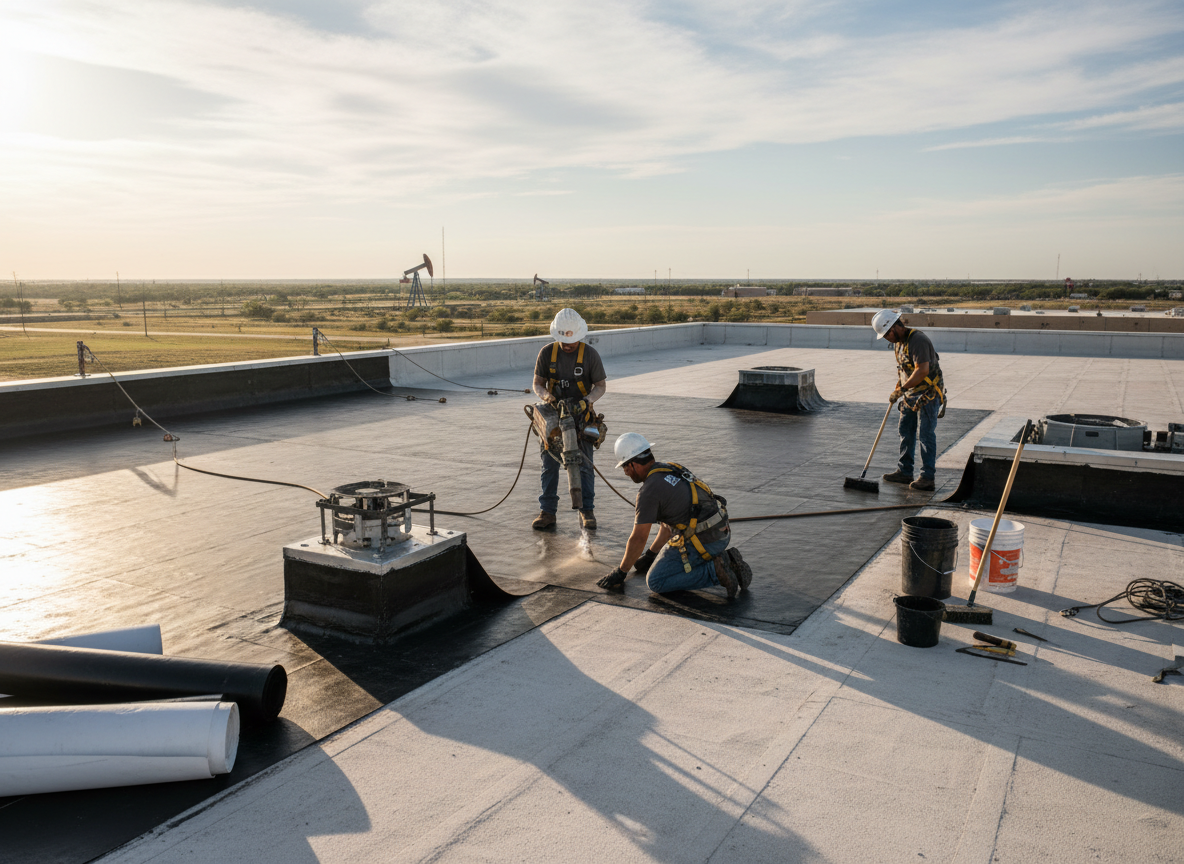
Roof waterproofing in Texas is less about a single product and more about the details that move water off a home: underlayment, valleys, sidewall and chimney flashing, pipe boots, drip edge, and the membrane over any low-slope section. In Houston's subtropical climate, with hot humid summers and mild winters, those details take a beating that shingles alone never see. Rain here often arrives sideways in storm bands, driven by wind that pushes water up under laps and behind siding, while months of UV bake the flexibility out of anything exposed. Homeowners in the Heights, Montrose, Midtown, and Downtown frequently have a 1920s–1950s bungalow with a flat-roof addition or a porch tie-in, and that seam is usually where the trouble starts.
Out in Katy, Sugar Land, and Pearland, the housing stock is newer and the roof geometry is more complex — multiple hips and valleys, dormers, and low-slope sections over garages and patios. Those subdivisions still sit in the same storm corridor. A twenty-minute downpour can drop more water than a gutter system can carry, and the first place it shows up is often a valley, step flashing at a brick wall, or a fastener backing out of the underlayment. Waterproofing there means re-establishing a continuous drainage path: full underlayment coverage, self-adhering membrane at the vulnerable zones, sealed penetrations, and a flat section that pitches to a drain or scupper instead of standing in a puddle for two days.
Diagnosis is where most waterproofing jobs succeed or fail. Water almost never enters where the stain appears — it rides a rafter, a top plate, or a vent pipe and drops somewhere else entirely. A useful inspection covers both sides of the roof: the attic for staining, damp sheathing, rusted fasteners, and daylight; the exterior for lifted laps, cracked sealant, corroded valleys, and penetrations sealed with a smear of tar. Repair versus replacement usually comes down to how widespread the failure is. Localized flashing and valley work on a roof with sound shingles is a repair. If underlayment is brittle, decking is soft, or low-slope sections have been patched repeatedly, re-waterproofing only the visible spot tends to buy one season.
Roofing isn't one system. Steep-slope asphalt shingles shed water through overlapping courses and depend on underlayment and flashing to handle what wind drives underneath. Metal roofs rely on seams, fasteners, and butyl sealant, and exposed-fastener panels are common on shops, barns, and carports from Katy toward the coast. Tile and concrete roofs, frequent in Sugar Land and the newer Pearland subdivisions, shed water well but their waterproofing layer is the underlayment beneath the tile, so a leak usually means underlayment work rather than tile work. Low-slope and flat roofs — TPO, modified bitumen, and coated systems — are a different discipline entirely, and commercial or institutional buildings near Minute Maid Park, the Museum of Fine Arts, and the Houston Zoo live or die on drainage, membrane seams, and flashing height, not shingle overlap.
Symptoms That Point to Failed Roof Waterproofing
- Brown rings, bubbling paint, or a soft spot on ceilings and upper walls, often well away from the actual entry point
- Dark streaks or damp sheathing on rafters in the attic, plus rusted nail heads and corroded fasteners
- Cracked, separated, or missing sealant at chimney and sidewall flashing, valleys, pipe boots, and vent stacks
- Granule loss or grit collecting at downspout outlets, which signals aged shingles and stressed underlayment
- Water still standing on a flat or low-slope section hours after the rain stops
- Daylight, damp insulation, or a draft around chimneys and where an addition ties into the main roof
- A musty smell in a hallway, closet, or garage that gets worse after a storm band moves through
- Lifted or curling shingle tabs along a rake edge or ridge, where wind has been working under the field
Roof Systems and Where Each One Fits
Not every waterproofing method belongs on every roof. The pitch, the existing material, and how the building drains decide what will actually hold.
- Asphalt shingle (steep slope). The right choice for most Houston-area homes and the most repairable system. Waterproofing means correct underlayment, self-adhering membrane in valleys and along eaves, and rebuilt flashing. Not appropriate to coat or seal over a shingle field that has already lost its granules — that hides the problem without restoring the drainage layer.
- Metal. Standing-seam panels rely on concealed clips and mechanically folded seams; exposed-fastener panels rely on gasketed screws and butyl tape. Waterproofing focuses on seam sealant, fastener replacement with neoprene washers, and termination details at ridges and eaves. Metal is a poor candidate for silicone coatings unless the panels are already weathered and chalking — coating a sound panel adds cost without an advantage.
- Tile and concrete. Common in Sugar Land and the newer master-planned subdivisions. The tile is a rainscreen; the underlayment beneath it is the waterproofing. Repairing a leak here is underlayment work, which means lifting and re-laying tile and replacing broken pieces. Not a coating candidate at all.
- TPO and single-ply membrane (low slope). Typical on commercial buildings, garage roofs, and additions. Waterproofing means heat-welded seams, proper termination bars, and flashing height above the anticipated ponding line. Not appropriate on a residential pitched roof — single-ply belongs where the pitch is under roughly 3:12.
- Modified bitumen and built-up (low slope). Older Houston flat roofs are full of it. Waterproofing is granule-surfaced cap sheet, reinforced flashing at penetrations, and a drainage path that actually works.
- Fluid-applied coatings. Silicone and acrylic coatings suit aged flat roofs that are structurally sound and dry. They fail when applied over trapped moisture, over a wet substrate, or as a fix for a roof that has no pitch at all.
How a Waterpro
Technician insight
In Houston, the thing that catches most people out with roof waterproofing is that the stain on the ceiling is rarely under the hole. Storm rain here blows in sideways out of the southeast and runs along a rafter or a conduit before it drops, so a leak showing up in a Midtown hallway can be entering at a chimney twenty feet away. The second one is the older housing stock in the Heights and River Oaks, where plank decking and original underlayment have been patched with tar for decades — sealing over that without replacing the underlayment mostly just moves the leak to the next seam.
Water Staining Under a Midtown Bungalow's Flat-Roof Addition
A Midtown homeowner called after a ceiling stain kept returning despite two separate shingle patches over the same area. On inspection, the shingles were fine — the failure was the tie-in where a flat-roof rear addition met the pitched roof, and the membrane there had shrunk and pulled away from the wall. We removed the failed material, rebuilt the transition flashing, and installed a new reinforced membrane over the low-slope section with drainage directed to the existing scupper. The ceiling stayed dry through the next round of storm bands.
Roof Waterproofing Services We Offer
✓Roof Flashing Repair and Sealing
Chimney, sidewall, step, and counter-flashing rebuilt with new metal and correctly layered sealant so water cannot get behind a wall or brick veneer. Common on Heights and Montrose bungalows where flashing was tarred rather than replaced.
✓Flat and Low-Slope Roof Waterproofing
Membrane, cap sheet, and termination work on garage roofs, rear additions, and commercial buildings where pitch is too low for shingles. Focuses on welded seams, flashing height, and a drainage path that actually carries water away.
✓Roof Leak Diagnosis and Repair
Attic-side and exterior investigation to find the real entry point before anything is sealed, followed by repair of the specific detail that failed. Useful when a stain keeps coming back after previous patches.
✓Valley and Penetration Sealing
Valleys, pipe boots, vent stacks, and HVAC curbs re-waterproofed with new membrane and boots rather than surface sealant. These are the most common leak points on steep-slope roofs in the Houston area.
✓Metal Roof Waterproofing and Seam Sealing
Seam sealant, fastener replacement with gasketed washers, and termination details on standing-seam and exposed-fastener panels. Suits shops, carports, and rural buildings from Katy toward the coast.
✓Tile Roof Underlayment Waterproofing
Lifting and re-laying tile to replace the underlayment that does the actual waterproofing. Relevant to tile and concrete roofs in Sugar Land, Katy, and the newer Pearland subdivisions.
✓Reflective Roof Coating Application
Silicone or acrylic coating applied to a sound, dry, aged flat roof to restore a water-resistant surface and reduce heat gain. Not appropriate over trapped moisture or a roof with no positive drainage.
How it works
- 1
Water Test and Leak Mapping
Where the source is unclear, controlled water testing on the roof while someone watches from the attic can trace the path water actually takes. This step usually settles the question of which detail has failed.
- 2
Deck and Substrate Assessment
Sheathing, fasteners, and underlayment are checked directly rather than assumed from the surface. Soft decking, rusted nails, or brittle underlayment change what the repair has to include.
- 3
Written Scope and Material Selection
The findings become a written scope naming the membrane, flashing metal, and coating or membrane system, along with the areas covered. Material is matched to pitch, existing roof type, and drainage.
- 4
Waterproofing Installation
Failed material is removed rather than covered. Flashings are rebuilt, penetrations are re-booted, membranes are welded or adhered, and coatings are applied only to a dry, prepared substrate.
- 5
Verification and Walkthrough
The completed work is checked for adhesion, seam integrity, and drainage, and the roof is walked with you so you can see what changed. Cleanup includes a sweep for nails and fasteners.
Pricing
Waterproofing cost tracks roof size and pitch, how many penetrations and valleys must be opened, access and safety requirements, and whether the job is a targeted repair or a full steep-slope or low-slope system. A single flashing rebuild and a new flat-roof membrane are not comparable projects, so pricing follows inspection rather than a per-square-foot figure given over the phone.