Roof maintenance in Houston is less about patching holes and more about managing water, heat and time. The city sits in a subtropical pocket where summer heat indexes climb past 105, humidity rarely drops below 60 percent, and a single afternoon thunderstorm can drop two inches of rain on a 1920s bungalow in the Heights and a newer subdivision in Katy in the same hour. Roofs here do not fail dramatically; they fail slowly. Granules wash into gutters, sealant around pipe boots dries and cracks, and decking stays damp long enough for rot to start. A maintenance program is often the difference between replacing three pipe boots and replacing the sheathing underneath them.
UV exposure is the quiet killer. Asphalt shingles that carry a 25- or 30-year rating in a northern climate often deliver far less real service across Harris County, because the sun degrades the asphalt binder long before the mat fails. Add hail — the Houston metro sits in one of the more hail-prone corridors in the state — and you get shingles that are bruised rather than torn, which is nearly impossible to see from the ground. Wind-driven rain finds every gap in step flashing, and the same storm that strips a ridge cap can leave a Sugar Land roof looking untouched. Maintenance means checking the things a storm does not visibly break.
Which maintenance tasks matter depends entirely on what is over your head. Asphalt shingle roofs — still the majority in River Oaks, Midtown and Pearland — need granule checks, sealant refresh at penetrations, and prompt replacement of cracked pipe boots. Metal standing-seam roofs need fastener and gasket inspection and a look at panel-to-panel sealant, not shingle-style repairs. Tile roofs, common on Spanish and Mediterranean-style homes, shed water well, but the underlayment beneath them is the real roof, and it ages out decades before the tile does. Low-slope and flat sections — porches, additions, garages, and most commercial buildings downtown — are usually modified bitumen or TPO, where seam integrity, ponding and drain condition drive everything.
Maintenance is not a substitute for replacement, and honest contractors will say so. If a large share of the roof is at the end of its service life, or if decking is soft across multiple areas, spending on maintenance just delays the inevitable. But a roof with localized flashing failures, a handful of lifted shingles, or a clogged valley is a strong maintenance candidate. Permits vary by municipality — Houston, Katy, Sugar Land and Pearland each handle re-roofing and structural repair differently, and many HOAs add their own architectural review — so confirm what your specific job requires before work starts. Texas Roof Specialists connects homeowners with vetted local crews, and RCAT certification is one of the credentials we look for.
What Roof Maintenance Actually Prevents
Most Houston roof failures trace back to a short list of repeat offenders. A maintenance visit is built around catching them before they reach the ceiling drywall.
- Cracked or dried pipe boots and vent seals. The single most common leak source on Texas roofs. The rubber collar around a plumbing stack bakes in the sun and splits, usually within a decade.
- Failed step and counter-flashing. Where a roof meets a chimney, dormer, wall or parapet, the metal carries the water. When the sealant behind it dries out, water runs sideways into the structure.
- Granule loss and thinning shingles. Granules are the shingle's UV armor. Once they are gone, the asphalt underneath cooks and the mat becomes brittle.
- Clogged valleys and gutters. Water that cannot leave the roof backs up under eaves and against fascia. In a two-inch downpour, a blocked valley can push water into a wall in minutes.
- Soft or delaminated decking. Long-term moisture, not impact, is what rots roof sheathing in a humid climate.
- Ponding water and blocked drains on low-slope sections. Flat porches, garages and commercial roofs live or die by drainage.
- Algae streaking and moss. Largely cosmetic in Houston, but moss and debris hold moisture against the shingle surface and accelerate granule loss in shaded neighborhoods.
- Compromised attic ventilation. Poor intake or exhaust airflow cooks shingles from below and traps moisture in the deck.
Roof Systems We Maintain, and What Each One Actually Needs
Asphalt shingle. The default across most of Houston — River Oaks, Midtown, Pearland, Katy subdivisions. Maintenance focuses on granule loss, sealant at penetrations, ridge and hip caps, and valley condition. Shingle roofs respond well to maintenance. They do not respond well to being patched repeatedly past their service life; once the mat is exposed across large areas, replacement is the honest answer.
Metal, including standing seam and exposed-fastener panels. Common on newer custom homes and many commercial buildings. Maintenance means checking fastener torque and gaskets, panel-to-panel sealant, and closures at ridges and eaves. Metal is a poor candidate for shingle-style patching — the right fix is usually a new gasket, a new fastener, or a sealant formulated for metal. The panels tolerate Houston UV well; the sealants and gaskets around them do not.
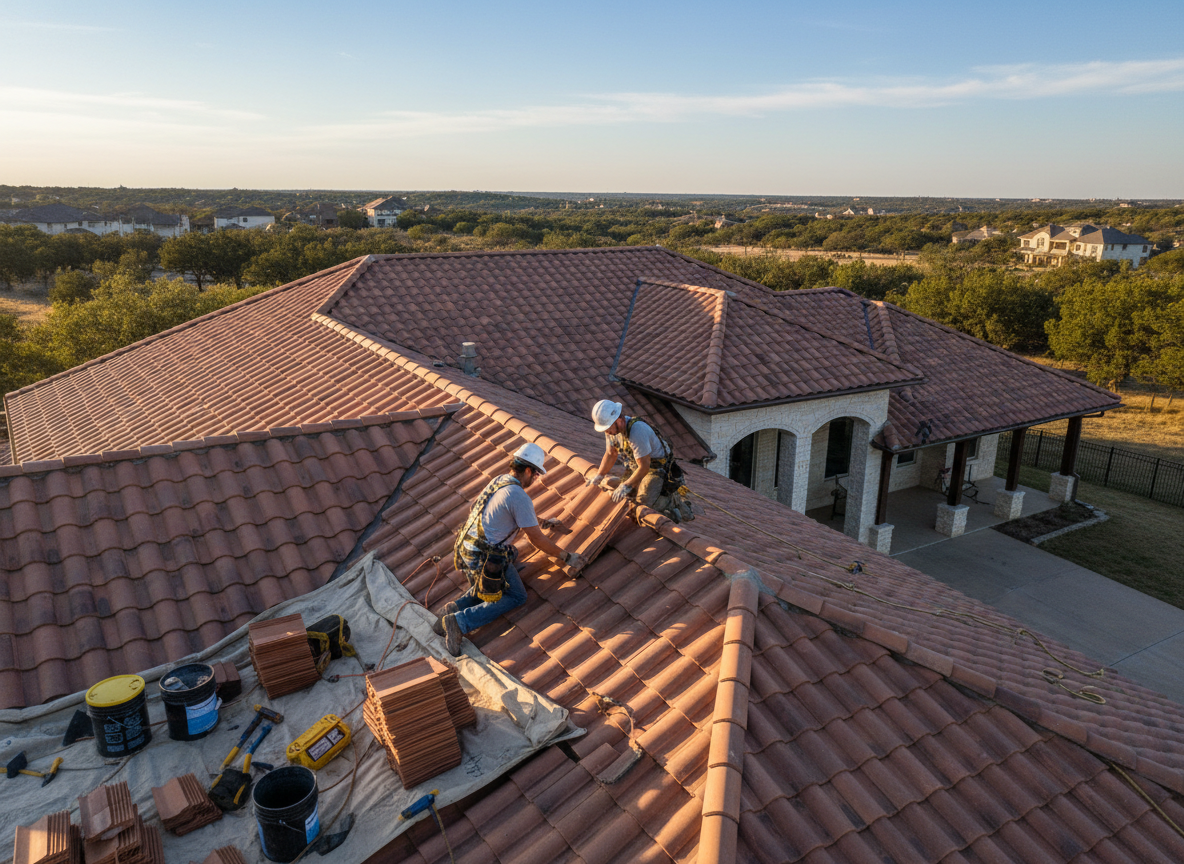
Clay and concrete tile. Found on Spanish and Mediterranean-style homes in older Houston neighborhoods. The tile itself can last generations, but the underlayment beneath it is the actual waterproofing layer and typically ages out far sooner. Maintenance on a tile roof means checking for cracked or slipped tiles, flashing at valleys and sidewalls, and the age of the underlayment. Walking a tile roof incorrectly breaks tiles — this is not a do-it-yourself surface.
TPO and single-ply membrane. The standard for flat and low-slope commercial roofs downtown and near the Museum of Fine Arts and Medical Center areas, and for some modern residential additions. Maintenance centers on seam integrity, drain and scupper condition, ponding, and rooftop penetrations from HVAC equipment. Coatings and sealants must be compatible with the membrane; a generic roof cement will not bond properly to TPO.
Modified bitumen and flat roof coatings. Common on older garages, porches, additions and small commercial buildings. These surfaces benefit most from a coating and seam-refresh program, but only if the membrane is still sound and drainage is corrected first. Coating over ponding water or a saturated substrate traps moisture and makes the eventual replacement more expensive.
Waterproofing at transitions. Where a pitched roof meets a low-slope porch, a dormer, a chimney or a parapet wall, the details — step flashing, counter-flashing, transition membranes — carry the water. These are the highest-failure areas on Houston roofs and the ones most often skipped during a quick visit.
Repair or Replace? The Factors That Actually Decide It
Age alone does not settle the question. A well-ventilated 18-year-old shingle roof in Pearland may have more life left than a poorly ventilated 12-year-old roof in Midtown. What matters is condition, extent and water risk.
- How much of the roof is affected. Localized failures — one valley, a chimney, a run of pipe boots — are maintenance and repair territory. Widespread granule loss, curling across multiple slopes, or brittle shingles throughout point toward replacement.
- Decking condition. Soft, delaminated or stained sheathing under more than a small area usually means the roof has been leaking for a while. That changes the scope regardless of what the shingles look like.
- Number of separate leak points. One leak is a repair. Four unrelated leaks in a season suggest the roof as a system is failing.
- Layers. A roof that has already been layered over an existing roof limits what maintenance can accomplish and adds weight and heat.
- Drainage and ponding. On low-slope sections, standing water shortens membrane life no matter how good the seams are.
- Timeline. If you plan to sell within a year, a documented maintenance history and a clear picture of remaining life are worth more than a patch.
A maintenance visit should end with a straight answer about which category your roof is in — not a sales pitch.
A Seasonal Roof Maintenance Calendar for Southeast Texas
Late winter to early spring (February–April). Pre-season inspection before hail activity picks up. Check flashing, boots and ridge caps, and clear winter debris from valleys and gutters.
Late spring (May–June). Post-storm checks. After a hail event, look for bruised shingles, dented soft metals and displaced ridge caps rather than obvious holes.
Summer (July–August). Attic ventilation and moisture check. This is the season that stresses shingles most; it is also the worst time of day to walk a roof, so schedule early morning work.
Fall (September–November). The most useful maintenance window of the year. Clear gutters and downspouts before the heavier rain pattern, refresh sealant at penetrations, and address anything the summer exposed.
Winter (December–January). Mild and generally workable. A good window for repairs that were deferred, and a chance to check for condensation or deck staining in the attic.
Roof Maintenance, Roof Repair and Roof Replacement Are Not the Same Thing
Homeowners often use these interchangeably, and contractors sometimes encourage that. They are different scopes with different pricing.
Maintenance is preventive work on a roof that is fundamentally sound: re-sealing penetrations, replacing cracked boots, clearing drainage, refreshing coatings, checking ventilation. It is scheduled, not reactive.
Repair addresses a specific failure — an active leak, a damaged section of flashing, a run of wind-lifted shingles. Repair is reactive and scoped to the problem.
Replacement is a full tear-off or overlay when the roof as a system has reached the end of its service life or the damage is too widespread to manage.
A good maintenance visit tells you which of the three you are actually facing, and does not blur the line to inflate the ticket.
Permits, HOA Review and Local Rules
Permit requirements for roofing work vary by municipality and by the scope of the job. Routine maintenance — sealant refresh, gutter clearing, boot replacement — typically does not require a permit. Structural repairs, decking replacement and full re-roofs often do, and the rules are not uniform across the region. Houston, Katy, Sugar Land and Pearland each handle permitting differently, and unincorporated Harris County addresses it differently again.
Homeowner associations add a second layer. Many Houston-area HOAs require architectural review before a roof is replaced, and some specify approved shingle colors or profiles. If you are in a deed-restricted community, check the HOA rules before materials are ordered — not after.
Confirm what your specific job requires before work begins. It is a short phone call that prevents a long problem.
Technician insight
In Houston, the thing that catches most people out with Roof Maintenance is that the roof looks fine from the street while the actual failure points are invisible — on a 1950s ranch house in the Heights or a bungalow in Montrose, the pipe boots and valley flashing are usually the first things to go, not the field shingles. Homeowners also tend to schedule maintenance in spring, right when everyone else does; late fall, after summer UV has done its damage and before the heavier rains, is a better window. And because so many Houston homes have a low-slope porch or addition tied into a pitched roof, a maintenance visit that only looks at the shingles misses half the roof.
A Heights Bungalow With a Stain Above the Kitchen
A homeowner called after a brown ring appeared on the kitchen ceiling following a heavy rain. The shingles over that room looked intact from the ground, but the attic showed staining along a plumbing vent and a soft patch of decking around it. The pipe boot collar had cracked and the surrounding sealant had dried out, so water had been running down the stack for some time. Replacing the boot, re-sealing the penetration and treating the damp decking stopped the leak, and a follow-up check after the next storm confirmed the ceiling stayed dry.
Roof Maintenance Services We Offer
✓Annual Roof Inspection and Tune-Up
A full walk of the roof, attic and drainage path to catch granule loss, cracked sealant and early flashing failures before they turn into interior leaks.
✓Gutter and Drainage Maintenance
Clearing gutters, downspouts and valleys so the heavy downpours common along the Gulf do not back up under eaves or pool against the foundation.
✓Flashing and Penetration Sealing
Re-sealing pipe boots, vent stacks, chimney counter-flashing and wall step flashing — the joints where most Houston roof leaks actually start.
✓Hail and Wind Damage Assessment
A close inspection after a storm to distinguish bruised shingles and lifted ridge caps from cosmetic marks, so you know what needs attention and what does not.
✓Attic Ventilation and Moisture Check
Checking intake and exhaust vents, insulation contact and signs of condensation or deck staining that shorten shingle life from underneath.
✓Roof Coating and Sealant Refresh
Reinforcing seams and applying compatible coatings on low-slope and modified bitumen sections — porches, garages, additions and small commercial roofs.
✓Algae, Moss and Debris Treatment
Removing tree litter, moss and algae streaking that hold moisture against shingles and speed up granule loss in shaded Houston neighborhoods.
How it works
- 1
Walk the Roof, Attic and Grounds
A maintenance visit covers three areas, not one. The roof surface shows granule loss, lifted shingles and flashing condition. The attic shows staining, soft decking, ventilation problems and where water is actually going. The grounds show how gutters and downspouts discharge and whether drainage is working against the house.
- 2
Sort Findings by Water Risk
Not everything found on a roof needs work today. Findings get grouped into active water entry, conditions likely to fail within a season, and items worth watching. That ordering is what keeps a maintenance visit from turning into an upsell.
- 3
Complete the Maintenance Work
Typical work includes replacing cracked pipe boots, re-sealing penetrations and transitions, re-securing lifted shingles or caps, clearing valleys and gutters, and refreshing coatings on low-slope sections where the membrane is still sound.
- 4
Review Findings and Set the Next Interval
You get a plain explanation of what was found, what was done, and what to watch. The next check date is set based on roof age, tree cover, material and whether the property has low-slope sections that need closer attention.
Pricing
Roof maintenance pricing in Texas is driven by roof size, pitch and accessibility, the number of penetrations and transitions, and how much repair work the visit uncovers. A straightforward single-story shingle roof with a handful of pipe boots takes far less time than a two-story home with multiple valleys, a tile section and a low-slope addition. If maintenance turns into repair — replacing boots, re-flashing a chimney, treating soft decking — the scope and cost change, and it should be quoted separately before work begins. Coating programs on low-slope sections are priced by square footage and prep work, not by a flat rate.