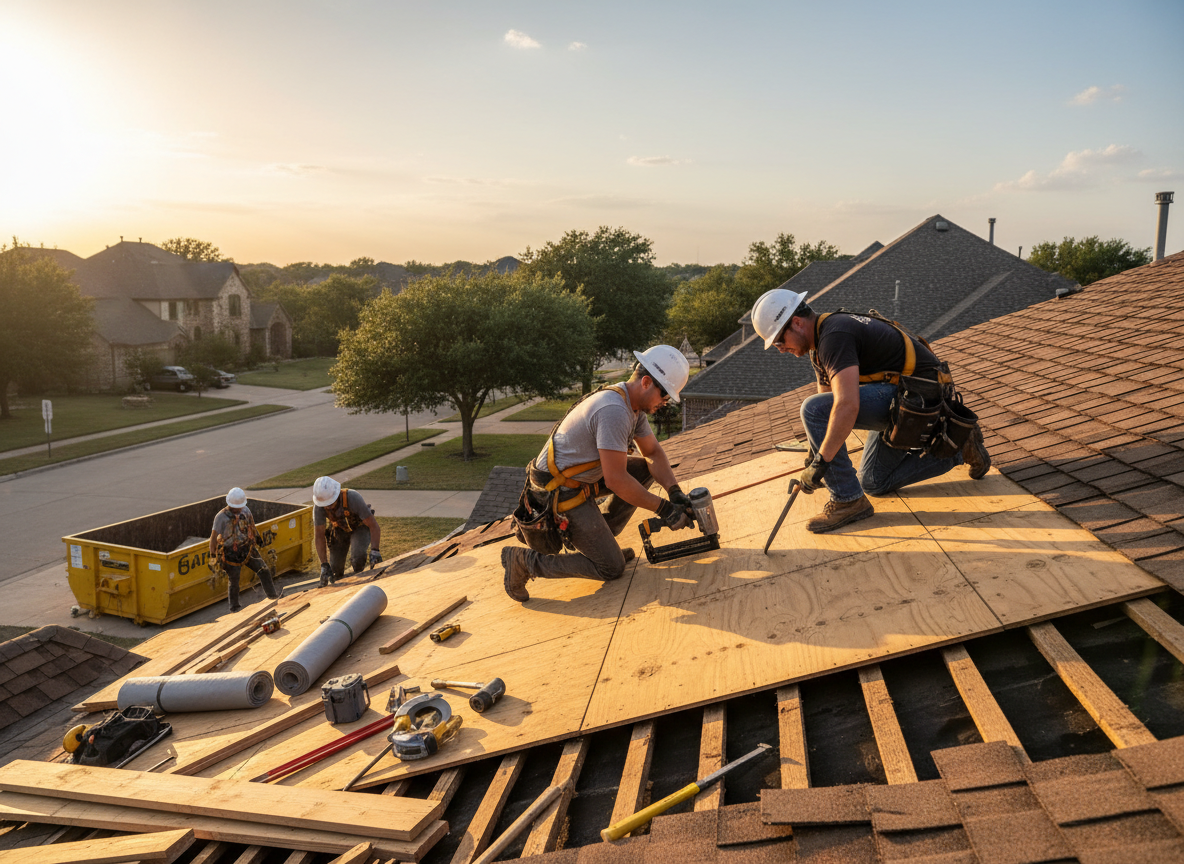
Roof decking — the plywood or OSB sheathing nailed across your rafters — is the part of the roof nobody sees and everybody depends on. Shingles, tile, metal panels and low-slope membranes are just the weather skin; the deck is what carries foot traffic, holds fasteners, and keeps wind and rain from pushing straight into the attic. When a Houston homeowner says the roof 'feels spongy' near a valley, or a roofer steps through a panel during a repair, that's decking failure, not shingle failure. Repairing it means cutting out the compromised panel back to solid wood, matching thickness and span rating, re-nailing to the framing, and only then rebuilding the weather skin above it. Skipping that step is why so many Houston re-roofs leak again within a season or two.
The local climate is hard on sheathing in a specific way. Subtropical summers push attic temperatures high enough to bake moisture out of wood and then re-condense it on cool nights, so panels that got wet once during a heavy-rain event or a tropical system tend to stay marginal for years. Add UV that degrades any exposed decking between tear-off and re-cover, hail that bruises panels and knocks granules loose, and wind-driven rain that finds its way past lifted shingle edges, and you get the classic pattern: a small leak at a pipe boot or valley turns into a soft, delaminated panel two or three rafters wide. Mild winters mean we rarely get freeze-thaw heaving, but the long humid season makes fungal decay and wood rot more likely here than in drier Texas markets.
Diagnosis is the whole job. A proper decking inspection starts in the attic where possible — looking for daylight, water staining, sagging between rafters, and dark or crumbly wood — then moves to the roof surface for a hands-on check of soft spots, nail pull-through, and panel edges that have swelled and no longer sit flush. Moisture readings and a probe tell you whether a panel is surface-stained or structurally gone. From there the decision is usually panel-by-panel: sound decking gets re-nailed and re-covered, marginal decking gets sistered or braced, and only genuinely failed sheathing gets cut out. That approach keeps roof decking repair proportionate instead of turning every soft spot into a full tear-off.
Which roof system sits on top changes how decking repair is sequenced. Asphalt shingle roofs are the most forgiving — the shingles come up in courses, decking is replaced, and new underlayment and shingles go back down. Tile and metal roofs need the panels or tiles carefully removed and set aside so they can be reused, which is slower and more labor-intensive. Low-slope and flat assemblies — TPO, modified bitumen, coatings — usually mean cutting the membrane, repairing the deck, then re-welding or re-laying the membrane with proper terminations, because a patch over a soft spot will telegraph through within a season. On commercial low-slope buildings, decking may be lightweight insulating concrete or steel deck rather than wood, and that calls for a completely different repair method than a residential plywood panel.
Technician insight
In Houston, the thing that catches most people out with roof decking repair is how far a small leak has already spread before anyone notices. A pipe boot or valley that's been weeping since a heavy-rain event will rot a panel two or three rafters wide, and in older Heights and Montrose bungalows with thin, widely spaced sheathing, the damage runs further than the stain on the ceiling suggests. The other mistake is letting a roofer re-cover soft decking because the shingles look fine — in this humidity, that panel keeps decaying under the new roof and you're back in the attic within a couple of seasons.
Soft Spot Over a Heights Bungalow Kitchen
A homeowner noticed a brown ring on the kitchen ceiling that reappeared after every heavy rain, and a roofer's probe near the valley found the sheathing spongy across several panels. Opening the roof showed a failed valley flashing had been weeping for years, rotting plywood and softening one rafter top. The crew cut the decking back to solid wood, sistered the damaged rafter, installed new sheathing and rebuilt the valley with new underlayment and flashing before matching shingles back in. The ceiling stain was painted over and stayed dry through the following storm season.
Roof Decking Repair Services We Offer
✓Rotten Decking Replacement
Cutting out water-damaged, crumbly or fungal-decayed plywood and OSB back to solid wood, then installing new sheathing matched to the existing thickness and span rating.
✓Delaminated Plywood Decking Repair
Re-securing or replacing panels whose plies have separated from long-term moisture exposure, which shows up as a spongy feel underfoot and fasteners that no longer hold.
✓Roof Deck Leak and Moisture Inspection
Attic-side and roof-side evaluation for staining, daylight, sagging and elevated moisture readings to pinpoint which panels are actually compromised before anything is torn off.
✓Decking Repair Around Chimneys, Vents and Valleys
Targeted repair at the penetration points where flashing failures and concentrated water flow rot the surrounding sheathing first — chimney chases, pipe boots, skylights and valley boards.
✓Storm and Hail Decking Assessment
Post-storm evaluation of bruised, fractured or wind-lifted sheathing and pulled fasteners, documenting panel-by-panel condition so repairs match the actual damage.
✓Roof Deck Re-Nailing and Fastener Repair
Re-fastening sound panels to the rafters where nails have backed out, over-driven or missed the framing, restoring the deck's ability to resist wind uplift.
✓Sheathing Replacement During Roof Replacement
Replacing failed decking as part of a full re-roof, so new underlayment and shingles, tile or metal are installed over a flat, solid, properly fastened substrate.
How it works
- 1
Attic and Roof-Surface Evaluation
The roofer inspects from inside the attic where access allows — checking for daylight, staining, sagging between rafters and soft wood — then walks the roof to probe for spongy panels, swollen edges and fasteners that have pulled. Moisture readings help separate stained-but-sound decking from decking that has actually failed.
- 2
Scope and Panel Mapping
You get a written scope that identifies which panels are being replaced, which are being re-nailed or braced, and which are being left alone, along with the roof system above them. This is the point to confirm thickness, span rating and whether the repair is being permitted locally.
- 3
Careful Removal of the Weather Skin
Shingles, tile, metal panels or membrane are removed only over the repair area and, where possible, set aside for reuse. Underlayment and flashing are pulled back far enough to expose the full extent of the damaged decking rather than just the visible soft spot.
- 4
Decking Cut-Out and Replacement
Failed sheathing is cut back to solid framing, new panels are fitted with correct gaps, and everything is re-nailed to the rafters. Rafter condition is checked while the deck is open — a rotted rafter tail or top plate has to be addressed before new decking goes down.
- 5
Rebuild, Water-Test and Walkthrough
New underlayment, flashing and the original roofing material go back over the repaired deck. The area is checked for flatness and fastener placement, then reviewed with you, including what to watch for in the attic over the next heavy rain.
Pricing
Roof decking repair is priced by the square foot of decking actually replaced, plus the labor to remove and reinstall whatever roofing sits on top — so the same soft spot costs far more under tile or metal than under asphalt shingles. Attic access, roof pitch, height, how many layers of old roofing have to come off, whether rafters are also damaged, and whether the repair is tied to a full re-roof all move the number. Ask for the decking price and the roofing-material price separately so you can see what you're paying for.