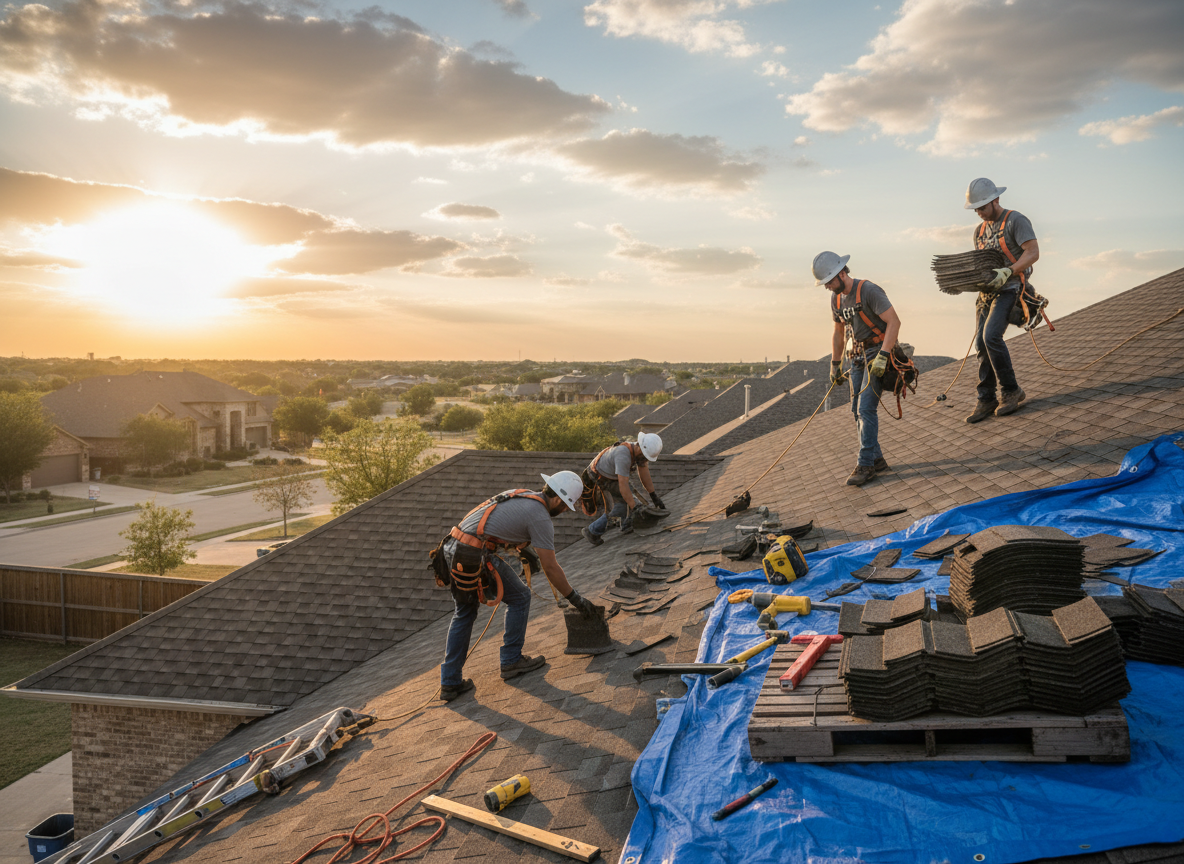
Roof damage repair in Houston is rarely a single-event problem. The subtropical climate here — hot, humid summers, mild winters, and Gulf moisture that never really leaves — works on a roof continuously rather than seasonally. Add hail bands that roll through Harris County, tropical-system wind, and the kind of heavy rain that dumps inches in an hour, and a roof that looks fine from the curb in River Oaks or Pearland can be quietly failing at a pipe boot, a valley, or a ridge. Repair work here starts with finding what actually failed, not with picking a material. A stain on a Montrose ceiling and a stain in a Katy two-story are usually two different jobs, even though the symptom looks identical from inside the house.
The damage patterns we see most often are cumulative. Intense UV degrades asphalt shingle mat and burns off granules, so shingles that were fine two summers ago are now brittle and crack instead of flexing. Wind — whether from a named storm or a routine spring squall — lifts tab edges, creases shingles, and pulls ridge caps loose, which opens the door to water tracking sideways under courses. Flashing is the quiet culprit: chimney and sidewall flashing, pipe boots, and drip edge all move with thermal expansion, and sealant that was fine at installation dries out and cracks. On low-slope and flat assemblies around Downtown, Midtown, and commercial corridors, the failure mode is different again — seams, ponding, and membrane blistering rather than blown-off shingles.
Material choice shapes what repair even means. Asphalt shingle dominates Texas residential roofs and is usually repairable in sections if the shingle line is still available and the deck is sound. Standing-seam metal and stone-coated metal hold up well against wind and UV but need fastener and gasket attention rather than patch-and-go repairs. Tile roofs — clay and concrete — are extremely durable surfaces with fragile pieces; the real work is often underlayment and broken-tile replacement, and walking them wrong causes more damage than the storm did. Low-slope systems like TPO, modified bitumen, and coatings are their own discipline, with seam welding, adhesion, and drainage slope matters that have nothing to do with residential framing. Matching the repair method to the system is the difference between a fix and a callback.
Repair versus replacement is a judgment call, and it should be made on evidence. Age of the roof, how widespread the damage is, whether the decking is soft, whether the same area has leaked before, and whether the shingle or membrane is still manufactured all matter. A localized repair makes sense when damage is confined and the rest of the assembly has life left. Replacement becomes the honest answer when damage is scattered across multiple slopes, when the underlayment is at the end of its service life, or when repeated repairs are chasing the same water. Local permits vary by municipality — the City of Houston, Katy, Sugar Land, and Pearland each handle roofing permits and inspections differently — so confirm what your specific job requires before work starts rather than assuming.
Technician insight
In Houston, the thing that catches most people out with roof damage repair is that the leak almost never starts directly above the stain. Water enters at a pipe boot, a valley, or a sidewall flashing and then runs along a rafter or the top of a ceiling joist before it drops — so a Midtown ceiling stain can trace back to a penetration ten or fifteen feet away. The other local gotcha is attic heat: in a Houston summer, an attic can sit hot enough that sealants and pipe boot gaskets dry out and fail years before the shingles around them do. Plenty of Katy and Sugar Land subdivisions went up in the 1970s and 1980s, and on those roofs the flashing is often the failing component, not the shingle field.
A Heights Bungalow Leaking at the Rear Slope
A homeowner in the Heights called about a brown stain spreading across a bedroom ceiling after a heavy rain. The visible shingles on the front slope looked intact, so we checked the rear slope and the attic: the leak traced to a cracked pipe boot and hail bruising on the rear field, not the front. We replaced the damaged shingles, installed a new pipe boot, and resealed the sidewall flashing where it met the brick. The ceiling dried out and stayed dry through the following week of storms.
Roof Damage Repair Services We Offer
✓Hail Damage Roof Repair
Repair of shingles, tile, and metal panels bruised or fractured by hail, including the soft-metal and ridge evidence that shows how far a hail band actually reached.
✓Wind and Storm Damage Roof Repair
Re-securing lifted, creased, or missing shingles and ridge caps after high wind, and checking that the underlayment beneath them is still intact.
✓Roof Leak Detection and Repair
Tracing an active leak to its real entry point — flashing, valley, pipe boot, or fastener — instead of patching the ceiling stain.
✓Flashing and Pipe Boot Repair
Repair or replacement of chimney, sidewall, skylight, and plumbing-vent flashing, the most common source of slow leaks on otherwise healthy roofs.
✓Flat and Low-Slope Roof Repair
Seam, blister, and ponding repairs on TPO, modified bitumen, and coated low-slope assemblies common on Houston commercial and garage roofs.
✓Metal Roof Panel and Fastener Repair
Replacement of damaged panels, resealing of fasteners and gaskets, and correction of oil-canning or lifted seams on standing-seam and metal shingle systems.
✓Tile Roof Underlayment and Broken Tile Repair
Replacing cracked or slipped clay and concrete tiles and addressing the underlayment beneath them, which usually fails long before the tile itself.
How it works
- 1
Report the Symptom, Not the Diagnosis
Tell us what you are seeing — a ceiling stain, granules in the gutter, a shingle in the yard, water at a wall base. That starting point tells us which slopes and penetrations to look at first.
- 2
On-Roof Inspection and Photo Documentation
A local roofer walks the roof and the attic where accessible, checking shingle condition, flashing, decking, and evidence of previous repairs, and photographs what they find so you can see it too.
- 3
Written Scope and Repair Options
You get a written description of the damage and the repair approach — what gets replaced, what gets resealed, and what is being left alone — so you can compare like with like.
- 4
Repair, Cleanup, and Verification
Work is completed, debris and nails are cleared, and the repaired area is checked under running water or the next rain event to confirm the leak path is closed.
Pricing
Roof damage repair pricing in Texas is driven by access and scope more than by square footage: a single pipe boot on a one-story Pearland ranch and a valley repair on a steep River Oaks tile roof are not comparable jobs. Expect the price to move with roof pitch and height, how many layers are already on the deck, whether matching material is still available, and whether decking or underlayment has to be replaced once the surface is opened. Get the scope in writing and compare the same items across quotes.