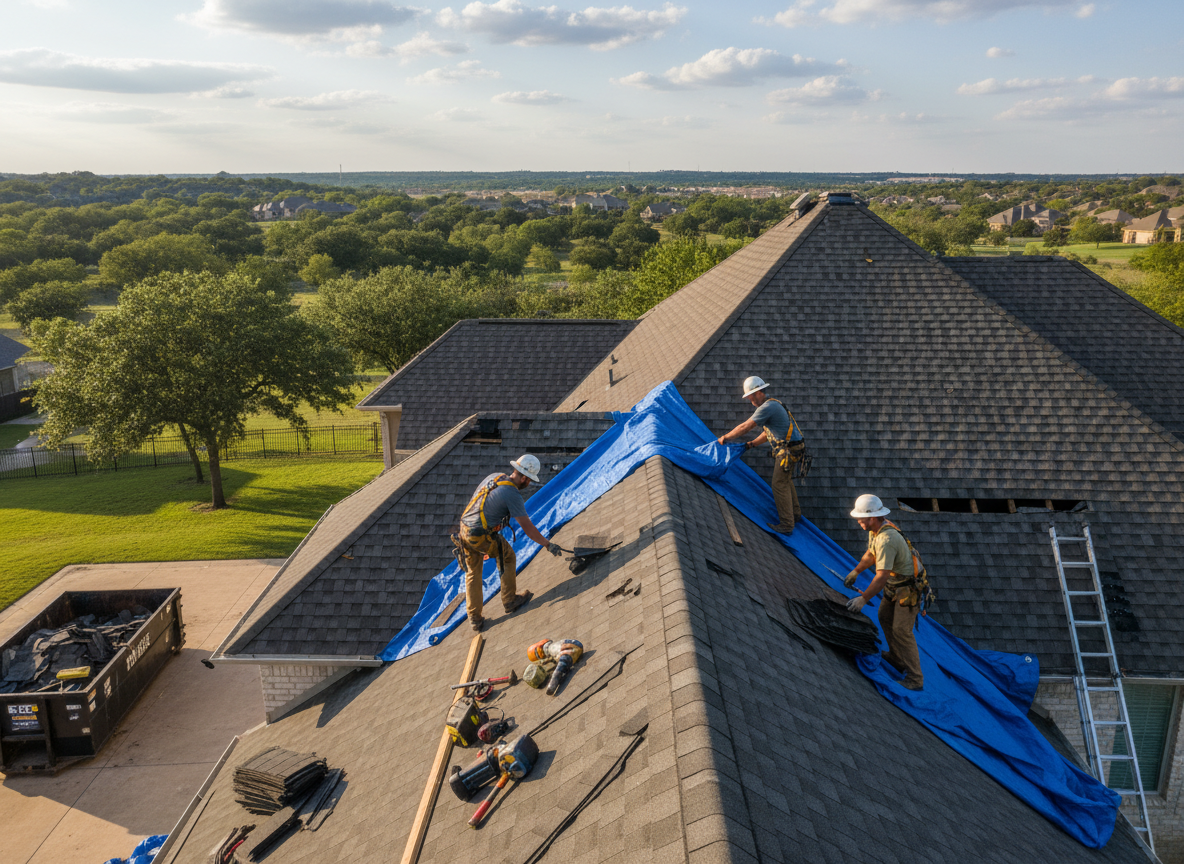
Emergency roof repair in Houston is rarely about a single dramatic event. It is usually the morning after a Gulf-fed thunderstorm when a ceiling stain appears in a Montrose bungalow, or the week after a hail core passes over Katy and a homeowner notices grit in the gutters and a soft spot near a valley. The subtropical climate here — hot, humid summers, mild winters, and rain that arrives in fast, heavy bands — means roofs stay wet, stay hot, and stay under thermal stress for most of the year. That combination ages sealants, opens nail pops, and turns a small flashing gap into a wet attic within one storm season.
What makes an emergency here different from a slow maintenance issue is water already inside the building. Once moisture reaches decking, insulation, and drywall, the cost curve steepens quickly. In older Heights and River Oaks homes, that often means original plank decking, multiple layered roof systems, and chimney or dormer flashing that has been patched more than once. In newer master-planned subdivisions out toward Sugar Land and Pearland, it more often means builder-grade three-tab or architectural shingles, tight roof-to-wall details, and pipe boots that have dried out and cracked. Both fail, just for different reasons.
A proper emergency response starts with stopping water entry and stabilizing the roof, not with a sales conversation. That means tarping or temporary sealing where shingles are missing, checking whether the leak is actually at the stain or tracking along a rafter from somewhere else, and photographing conditions before anything is covered. Houston leaks are notorious travelers — water enters at a ridge or a vent and shows up ten feet away at a light fixture. Diagnosing the true entry point is the difference between a repair that holds and a repeat call next storm.
Repair versus replacement is a judgment call, not a script. A localized leak with sound decking, intact underlayment around it, and shingles that still lay flat is usually a repair. Widespread hail bruising, granule loss across whole slopes, wind creasing, or a roof already at the end of its service life points toward replacement. Because roofing permits and inspection requirements vary by municipality across Harris and Fort Bend counties, confirm what your specific city or MUD jurisdiction requires before work begins — the rules are not uniform across the metro.
Technician insight
In Houston, the thing that catches most people out with Emergency Roof Repair is assuming the leak is directly above the stain. With the humidity and heat we run here, water gets into a ridge vent, a pipe boot, or a chimney flashing and then tracks along a rafter before it drops — so a ceiling stain in a Midtown townhome or a Heights bungalow can sit fifteen feet from the actual opening. The second surprise is attic heat: a dark, poorly ventilated attic bakes shingle underlayment and dries out sealant faster than most homeowners expect, which is why so many of these roofs fail at the details rather than the field.
Ceiling Stain Two Rooms Away From the Leak
A homeowner near the Heights called after a heavy overnight storm left a spreading stain on a bedroom ceiling, well away from any roof penetration visible from the ground. Inspection found the entry point at a cracked pipe boot over the hall bathroom, with water tracking along a rafter and dropping at the bedroom. The boot was replaced, the surrounding shingles reset, and the attic sheathing was checked for saturation. The ceiling dried without further damage, and the homeowner now knows where to look first the next time a storm rolls through.
Emergency Roof Repair Services We Offer
✓Storm and Wind Damage Roof Repair
Repair of shingles lifted, torn, or creased by straight-line winds and downdrafts. Includes re-securing or replacing damaged field shingles, ridge caps, and edge metal.
✓Hail Damage Roof Repair
Assessment and repair of hail-bruised shingles, fractured tile, and dented metal where the impact has compromised the mat or coating. Localized sections can often be replaced rather than the whole roof.
✓Active Roof Leak Repair
Tracing and sealing an active leak while it is still wet — including leaks that travel along rafters and surface well away from the actual entry point.
✓Emergency Roof Tarping and Water Intrusion Control
Temporary tarping and sealing to stop water entering during or immediately after a storm, buying time for a permanent repair once conditions allow.
✓Missing Shingle and Ridge Cap Repair
Replacement of blown-off field shingles, hip and ridge caps, and starter course along eaves where wind gets its first grip.
✓Flashing, Pipe Boot and Valley Repair
Resealing or rebuilding the details that cause most leaks — chimney and sidewall flashing, dried-out pipe boots, and valley metal that has rusted or pulled loose.
✓Flat and Low-Slope Roof Leak Repair
Leak repair on TPO, modified bitumen, and built-up low-slope systems common on Houston garage roofs, additions, and small commercial buildings. Ponding and seam failure are the usual culprits.
How it works
- 1
Call and Describe What You Are Seeing
Report the symptom — ceiling stain, water at a light fixture, missing shingles, granules in the gutter — and whether water is actively entering. That determines whether the priority is tarping or a full diagnostic inspection.
- 2
Stabilize and Document
Where water is entering, the roof is tarped or temporarily sealed to limit interior damage. Conditions are photographed before anything is covered so the extent of damage is on record.
- 3
Inspect and Trace the Source
The roof, attic, and interior are inspected together. Because Houston leaks travel, the entry point is confirmed rather than assumed from where the stain appears.
- 4
Scope the Repair and Confirm Permits
You get a written scope separating immediate repair from anything deferred. Local permit and inspection requirements are confirmed with your municipality before work is scheduled.
- 5
Complete the Repair and Verify
Damaged shingles, flashing, or low-slope membrane are repaired, then checked with water testing where practical. Debris is removed and the repair is inspected with you.
Pricing
Emergency roof repair pricing in the Houston area is driven by access and extent, not by a flat rate. A single blown-off shingle section or a resealed pipe boot sits at the low end; tarping plus a traced leak with interior water damage, or repair on a steep two-story roof in River Oaks or the Heights, moves into a higher band. Low-slope membrane repair is priced by area and by whether the existing system can be patched or a section must be cut out and rebuilt. Expect the written scope to separate emergency stabilization from the permanent repair so you can see what you are paying for at each stage.