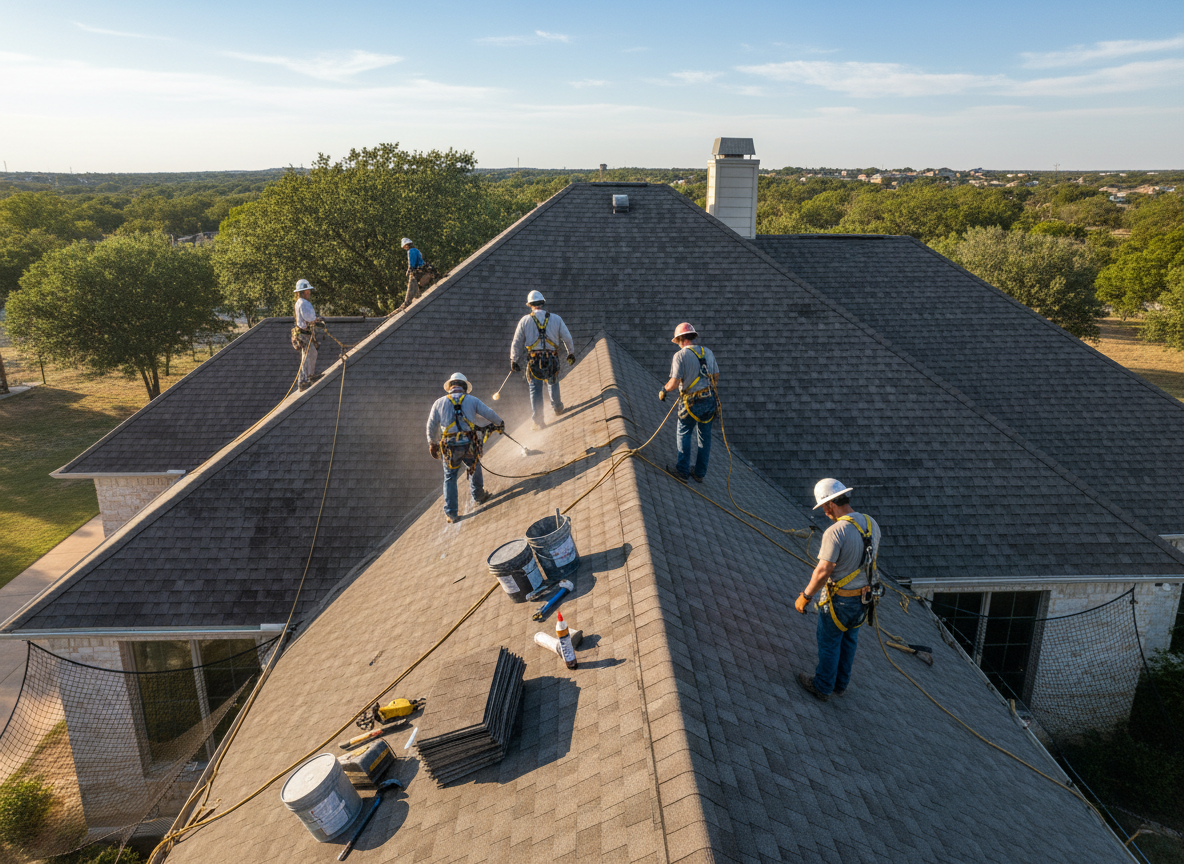
San Antonio roofs take a specific kind of beating. Summers here are long and hot, and the sun bakes shingle granules, dries out sealant around pipe boots and vents, and works on the caulk lines at flashing long before anything actually leaks into a ceiling. Winters are mild, which sounds forgiving until you remember that mild winters in this part of Texas still bring the occasional hard freeze that contracts metal and opens seams. Add the hail that rides in with spring and early-summer storms along the I-10 and I-35 corridors, and you get a roof that ages on two clocks at once — slow heat-and-UV decay, punctuated by sudden impact damage.
The housing stock matters as much as the weather. In and around Downtown, King William, Southtown and Alamo Heights, you have everything from century-old homes with steep pitches, dormers, and multiple roof planes to mid-century ranch houses and newer infill builds — often on the same block. That mix means no single roof system or repair approach fits the whole city. Historic-district homes frequently carry layered roofing, decorative trim, and tight lot lines; newer subdivisions out toward the ZIP codes along US-281 tend to have simpler gable and hip geometry but more ridge vents, valley flashing and penetrations to inspect. Access is its own variable: narrow streets, alley parking, mature pecans and oaks dropping limbs, and steep two-story elevations all change how a crew sets ladders, stages materials, and protects landscaping.
Texas Roof Specialists is a statewide roofing service-connection brand, with its business address in Houston, that helps San Antonio homeowners and property owners get connected with roofing professionals working in Bexar County. We are not claiming a San Antonio storefront or a standing local crew — we connect you with roofers who work this market, and RCAT Certification is part of the credential set we look for when we make those connections. Whether the job is a patched leak over a 78204 bungalow, a full tear-off and replacement on a 78209 home, or a post-storm inspection after hail moves through, the goal is the same: a clear scope, an upfront quote, and workmanship you can inspect before final payment.
Roof Repair Services Commonly Needed in San Antonio
Most repair calls in San Antonio fall into a handful of patterns. Wind and hail lift or bruise shingles and break the seal on ridge caps. Heat ages pipe boots, vent flanges and the rubber gaskets around them until water tracks down a nail or a vent pipe and stains a ceiling days later. Flashing failures show up at chimneys, sidewalls, and where a porch or addition roof ties into the main roof — common in the older, more additive housing around Downtown and Southtown. Valley and step flashing problems are frequent on the complex, multi-plane roofs found in King William and Alamo Heights. And then there are the slow ones: granule loss, curling tabs, exposed nail heads, and sagging decking that only become obvious during a heavy rain.
Repair work is usually scoped in tiers: resealing and replacing individual damaged shingles or tiles, replacing boots and vents, rebuilding flashing details, or addressing decking and underlayment where rot has set in. A good roofer will tell you when a repair is the right call and when repeated repairs are just paying toward a replacement you will need anyway.
Roof Replacement, Installation and Material Choices
When a roof is at the end of its service life, replacement usually means tear-off to the deck, inspection and replacement of any soft or delaminated sheathing, new underlayment, new flashing, and a new covering system. In San Antonio the common choices are architectural asphalt shingles, which handle the heat reasonably well at a range of price points; metal standing seam and metal panel systems, which reflect heat and shed hail better but cost more upfront; and tile or synthetic tile profiles, which appear on some of the Spanish-influenced and historic-adjacent homes in and around Alamo Heights and King William. Flat or low-slope sections — porches, additions, and some commercial buildings near Downtown — typically call for modified bitumen or a membrane system rather than shingles.
Installation quality is where most long-term performance is decided: proper underlayment laps, correct nailing patterns, ice-and-water or peel-and-stick at valleys and penetrations, adequate intake and exhaust ventilation so the attic does not cook the deck from below, and clean flashing details. Ventilation matters more here than in cooler markets because attic heat is relentless from May through September.
Storm and Hail Damage, Inspections and Maintenance
Hail and wind events are the biggest single driver of roofing claims in Bexar County. Damage is not always visible from the ground — bruised shingles, fractured mat, dented vents and gutters, and cracked seals can all be present on a roof that still looks intact from the driveway. A post-storm inspection should cover the field of the roof, ridges, valleys, flashing, penetrations, gutters, and any soft metals that record impact. If damage is found, documentation matters: photos, measurements, and a written scope help when working with an insurer.
Routine maintenance is the cheaper path. Once or twice a year — ideally before storm season and again in late fall — have someone clear debris from valleys and behind chimneys, check and reseal boots and exposed fasteners, trim tree limbs back off the roof, and confirm that attic ventilation and any roof-mounted equipment are sound. On the older homes around Downtown and Southtown, where roofs are often layered and details are fussy, that kind of periodic attention is what keeps small issues from becoming interior water damage.
Working With Roofing Contractors in San Antonio
Permitting for roofing work in Texas is jurisdiction-dependent: some cities and counties require a permit and inspection for re-roofs, others do not, and requirements can also hinge on whether the job is a repair or a full replacement. Before work starts, ask who is pulling any required permit, who handles the inspection, and what the disposal plan is for old material. Get a written scope that names the materials, the number of squares, what is being replaced versus reused, and what is excluded. Ask about the sequence for any deposit and final payment, and confirm that the crew will protect driveways, landscaping, and any rooftop solar or HVAC equipment.
Because San Antonio's housing ranges from historic to brand new, the most useful thing you can do is get a scope written for your specific roof — its pitch, its layers, its access — rather than a generic per-square number. That is what we aim to connect you with.
Around San Antonio
We regularly work near:
- 📍The Alamo
- 📍River Walk
- 📍San Antonio Zoo
- 📍King William Historic District
- 📍Southtown
- 📍Downtown San Antonio
Roof Repair in San Antonio — Local Notes
- •San Antonio's roofing season runs hot: from roughly May through September, attic temperatures and surface heat on shingles are high enough that crews often start early and stage work around afternoon heat. Heat-related failures — dried sealant, brittle pipe boots, granule loss — show up here as often as storm damage.
- •Historic and older neighborhoods such as King William, Southtown, Downtown and Alamo Heights frequently have layered roofing, steep pitches, dormers, and multiple roof planes, plus tight lot lines and mature trees. That combination affects how materials are staged, how ladders are set, and how long a repair or replacement realistically takes.
- •Hail and wind events along the I-10, I-35 and US-281 corridors drive most storm-damage calls in Bexar County. Damage is often invisible from the ground, so an inspection that covers ridges, valleys, flashing, vents and soft metals is the practical first step before assuming a roof is fine or assuming it needs full replacement.